
Turn chaotic workflows into learning systems.
Governed AI operations that decide, act, verify outcomes and learn what works.
Same models. Better decisions from verified experience.
Decide better · Act reliably · Learn safely
The model stays frozen. The system learns.
A model call is not a decision system.
Models can reason about a decision. They do not by themselves own durable state, verify real-world execution, distinguish policy failure from missing evidence, or turn verified outcomes into bounded future improvements. ReDevOps makes those Runtime responsibilities.
A request in, a response out. No durable state, no verification of what actually executed, no memory of the outcome.
Every consequential decision is observed, grounded in evidence, governed, executed, verified against reality — and turned into Experience the next decision can use.
Same model. Different Runtime. Different decisions.
Chess is the laboratory, not the product. It gives us a deterministic rule system and an independent oracle for measuring whether the Runtime itself improves decisions — while the model weights never change.
Frozen Qwen · 726 held-out positions · Stockfish 17.1 depth-16 deterministic evaluator · no model-weight changes.
A separate bounded external engine-hint arm reaches 0.167 — that is external assistance, not part of the Runtime claim.
Update, 27 October 2026 · internal rerun
Rerun with a different model (Qwen3.8-Flash-Next 8-bit): no Runtime 0.413 over all 726 positions (published 0.408); full Runtime 0.100 on 191 stratified positions against 0.426 without it on the same positions. The direction holds; the published 0.197 was not reproduced. The rerun's full-Runtime arm includes a depth-8 Stockfish hint, so its result includes engine assistance. The other arms were not run.
The learning curve has not been rerun and is awaiting reproduction (see the update in the architecture ablation card).
Held-out · model weights frozen · no fine-tuning. Learning is outcome-grounded, bounded and selectively applied.
The first result isolates what the Runtime stack adds; the second isolates learning from accumulated Experience. They are two separate experiments and stay separate — this is not a claim that ReDevOps makes any model 52% smarter.
One loop from observation to better future decisions.
rAIls forms one closed decision loop. Observation becomes evidence, evidence becomes a governed action, execution is verified against reality, and verified outcomes become Experience the system learns from — while the model stays frozen.
Discovery Runtime
Finds work worth doing — and evidence worth acquiring when a decision is evidence-limited.
under the hoodDecision Intelligence
Generates candidate actions — including HOLD / abstain — weighs trade-offs and chooses what should happen next.
under the hoodContext Runtime
Selects the evidence, representation, model, method and budget the decision needs.
under the hoodMission Runtime
Executes the chosen action with approval, replay, verification and recovery — event-sourced, per-node EXPLAIN.
under the hoodLearn
Turns verified outcomes into Experience → Pattern → Lesson → candidate improvements, applied selectively.
under the hoodGovernance + Evidence
Constrains the entire loop. Learning cannot rewrite authority, approval or security policy.
under the hoodRunning the stack in enterprise infrastructure? Extend the same runtime contracts with intrinsic security and telemetry, enterprise runtimes for Go, Kotlin and .NET, and data-platform integrations for Spark and Databricks — the production integration layer around the same architecture, not a separate proprietary AI stack. Explore Enterprise Edition
Don't learn when learning isn't the problem.
ReDevOps does not assume every decision should learn. It measures whether the bottleneck is policy, evidence or applicability — and routes accordingly.
The evidence supports better decisions than the current policy is making. Use verified outcomes to improve future selection.
The available evidence cannot distinguish the right action. Determine which additional observation could change the decision — and whether it is worth acquiring.
Prior Experience is not sufficiently applicable. Use the frozen policy, request more evidence, abstain or escalate to a human.
AI shouldn't learn everything. It should learn when Experience can help, discover when evidence is missing, and abstain when neither is reliable.
One decision architecture. Very different worlds.
The same Runtime contracts run across environments with very different oracles, outcomes and stakes. Each is a decision laboratory for the same question: can the same frozen model decide better from verified experience?
Asset allocation is the current research environment for path-dependent decisions, delayed outcomes, risk/return trade-offs and changing market regimes. The question is whether the same frozen model can improve as verified experience accumulates.
Repeated decisions across receivables, sales follow-up, fraud review, supplier reconciliation, support, renewals and other operational workflows — including when doing nothing is the right action. Synthetic worlds validate the mechanism; they do not clear the external-validity gate.
Known rules, an independent oracle and repeatable trials. Used to isolate what the Runtime adds before moving into weaker-oracle real domains.

Let AI do real work — without losing control.
Not a taxonomy — a real Mission. Here is one execution, start to sealed proof: what it knew, what it was allowed to do, who approved the consequential step, and how it was verified.
- OpenSanctions · company registry · CRM · 14 evidence objects
- SQL + property graph · score .94
- 09:42Authority checkCustomer records allowedSanctions lookup allowedExternal actionHUMAN APPROVAL
- Case status updated
- Expected state == observed state

Real workloads. Measured outcomes.
We test whether the Runtime makes better decisions — and whether unsafe ones get through.
Awaiting reproduction · 27 October 2026
The harness and the definition of the plan-quality metric behind these scores have not been located, so they are shown as published and not as a verified result.
How this was measured
The resolver classifies each parcel's official base zoning code into a residential, commercial or industrial family. It answers PERMITTED only for single-family residential on a residential code, PROHIBITED when the families differ, and UNKNOWN when the ordinance use-table is needed. A false-permit is a PERMITTED answer against an incompatible family. The zero follows from that rule, not from a ground-truth comparison, so it is a resolver property rather than an accuracy claim. The 32 parcels are a fixed, committed sample of the 149,624-district harvest index (kept off-repo); the run is offline and deterministic. A CI workflow re-runs it against pinned resolver commit ceeff63 and publishes the JSON (last run 2026-10-13: 7 permitted, 55 prohibited, 98 unknown, 0 false-permits). Re-run again on 2026-10-27: the same counts, with the same input hash.
Your systems become capabilities.
ReDevOps doesn't replace your models, agents, data stores or business applications — it gives them one common execution boundary.
- OpenAI
- Anthropic
- Gemini
- Local / PAIR
- LangGraph
- PydanticAI
- CrewAI
- Custom agents
- SQL
- Graphs
- RAG
- APIs
- Twenty
- ERPNext
- Chatwoot
- Lago
NVIDIA NeMo · PydanticAI · LlamaIndex · CrewAI · Azure Semantic Kernel · Google ADK / A2A · AWS Strands · DigitalOcean · LangGraph

Your rAIlsApps. One install.
Start with the machine and capabilities you already have. ReDevOps discovers what is available, asks before installing anything consequential, and gets you to a first Mission — not a config file.
What installs is a suite of source-available (AGPL-3.0 with the Commons Clause) apps — six governed domain agents on rAIls (source-available) — Revenue, Intelligence, Finance, Customer Success, Content, and Security & Compliance — over real open-source cores (Twenty, Metabase, Postiz and more). The apps are being made runtime-native: approvals gate consequential actions today, read-back verification is live for a few capabilities, and the priority engine and learning loop are rolling out across apps. Self-host it or run it on AWS, Google Cloud, Azure or DigitalOcean, with your own model. See the rAIlsApps.
$ git clone https://github.com/redevops-io/agentic-os
$ cd agentic-os/deploy/apps
$ docker compose up -d
See what's installed
One command stands up the whole agentic app — a single docker compose up on a host, or one helm install in a cluster — the runtime, the Projects Control Plane, the infra operator (deploy · provision · configure · verify · drift · rollback), the deployment skills, and a wired Prometheus + Grafana + Loki stack. Run AI on your own machines →
Wrap LangGraph, LangChain or your own agent as a governed capability — no framework rewrite. Mission SDK
Or point it the other way — let Claude, ChatGPT or Cursor drive your apps through the Governed Agent Gateway — governed, not an ungoverned backdoor.
See the Runtime work.
Four live surfaces, no signup — inspect the actual product, not a description of it.
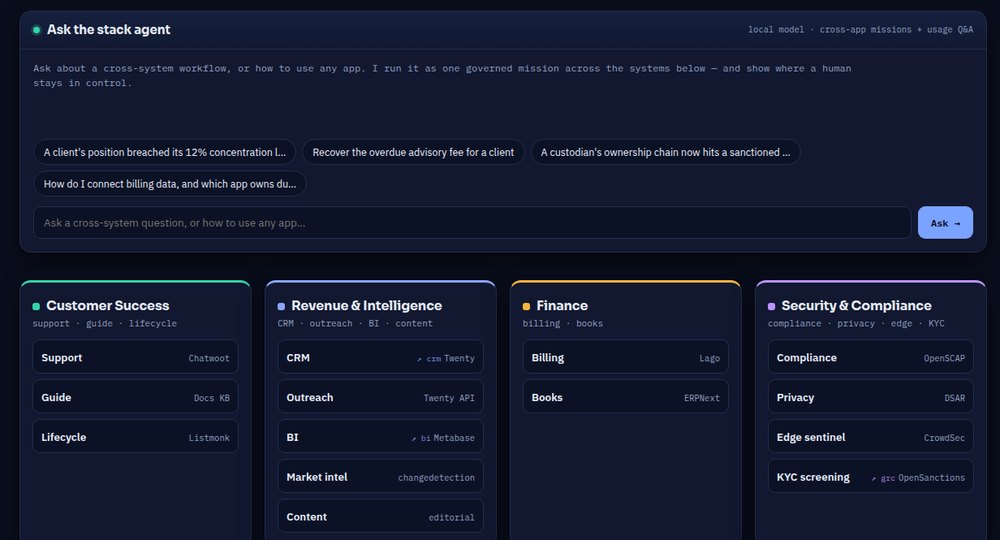
Live operating console
Run governed Missions across your business apps.
Open the live console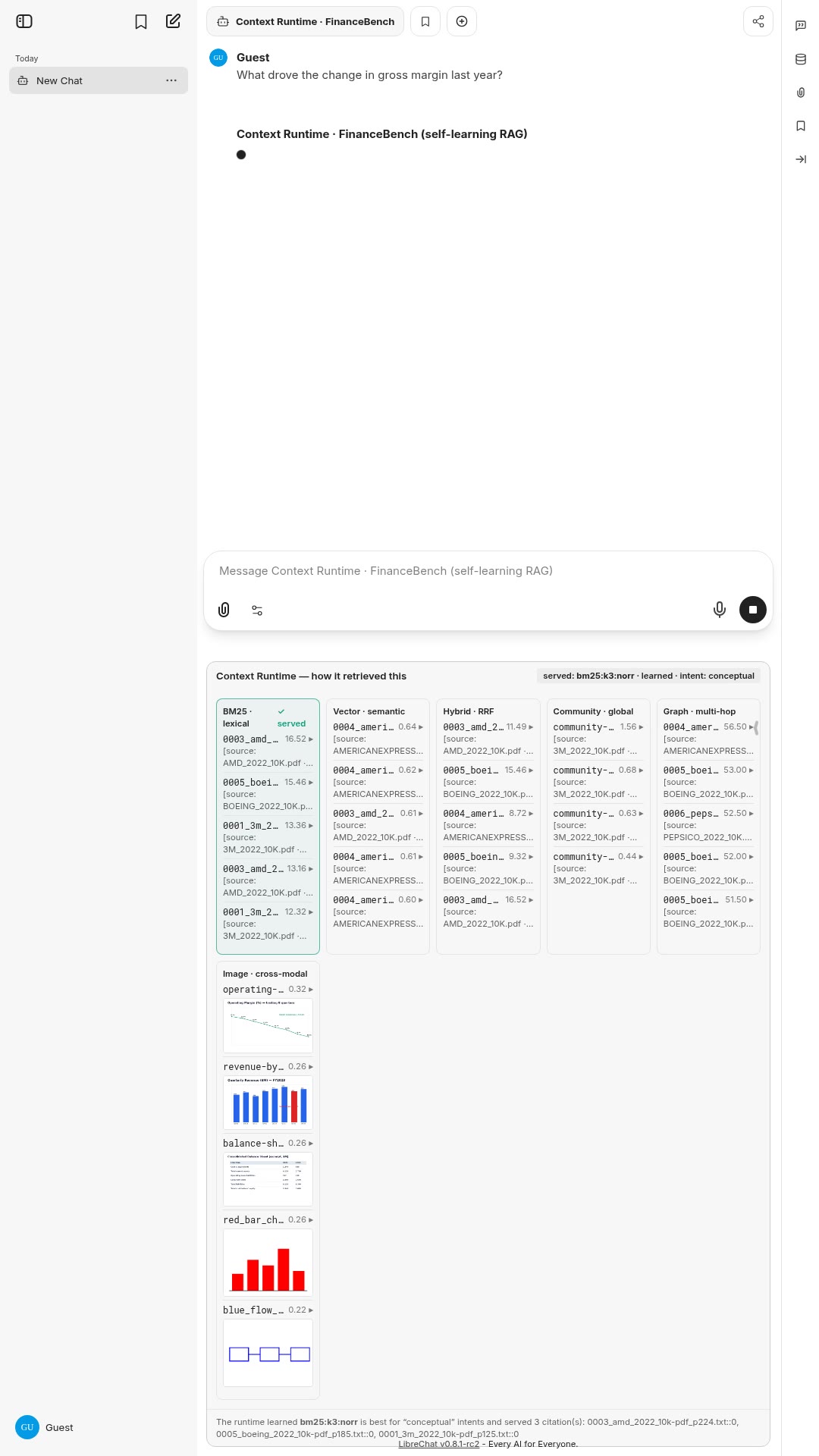
Context planner
Watch the context get selected — and explained.
Open the Context demo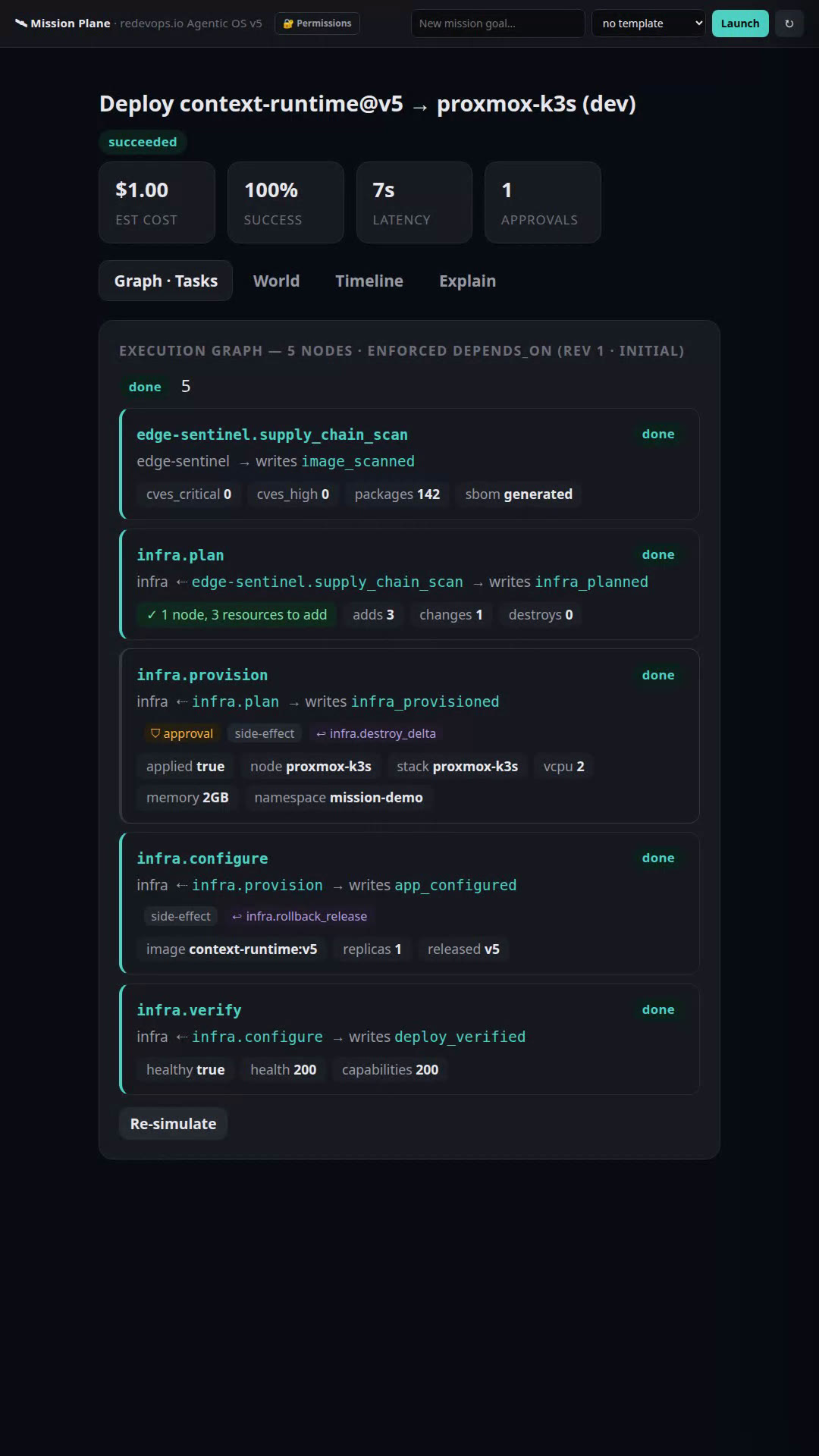
Mission Runtime
Watch plan → approval → execution → verify.
Watch a mission run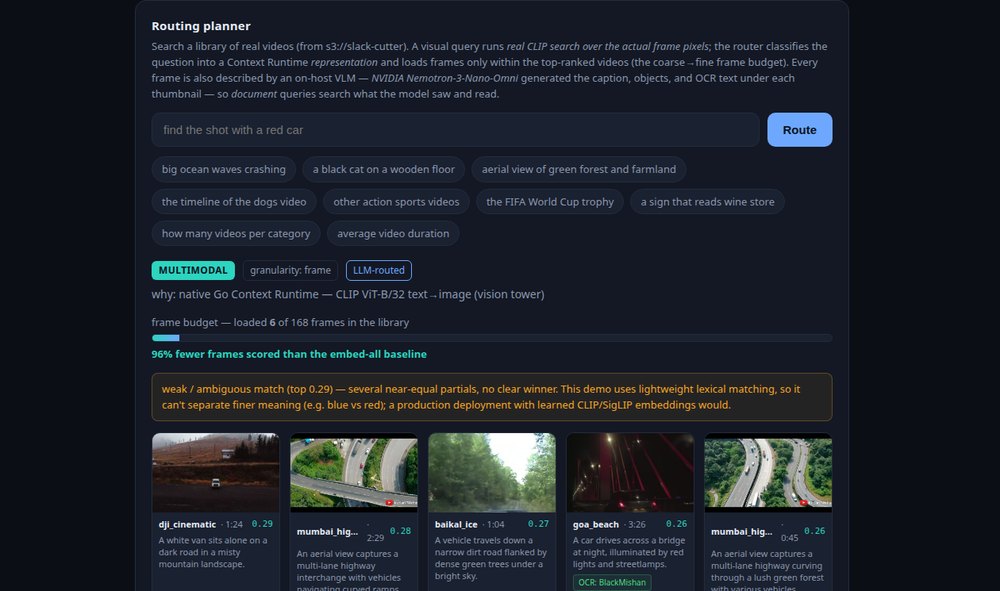
Go runtime
Run the zero-dependency runtime in your browser.
Run it in the browserBuild with it.
Open-core and self-hostable. Start from the SDK, wire the canonical contracts, or read the code.
$ docker compose up -dHave historical decisions and outcomes?
We are looking for design partners with repeated operational decisions where historical evidence, action logs and outcomes can be reconstructed. ReDevOps can begin read-only, replay the historical process, establish a baseline, and test whether Context, Decision Intelligence or verified Experience changes the result — before any production action is enabled.
Capable models need a Runtime that can decide, act, verify and learn.
Pick one repeated consequential decision. We determine whether the bottleneck is context, policy, missing evidence or execution — or whether the Runtime does not help.
Decide better · Act reliably · Learn safely