Discovery Runtime
11 slides · the proactive layer that decides what deserves attention
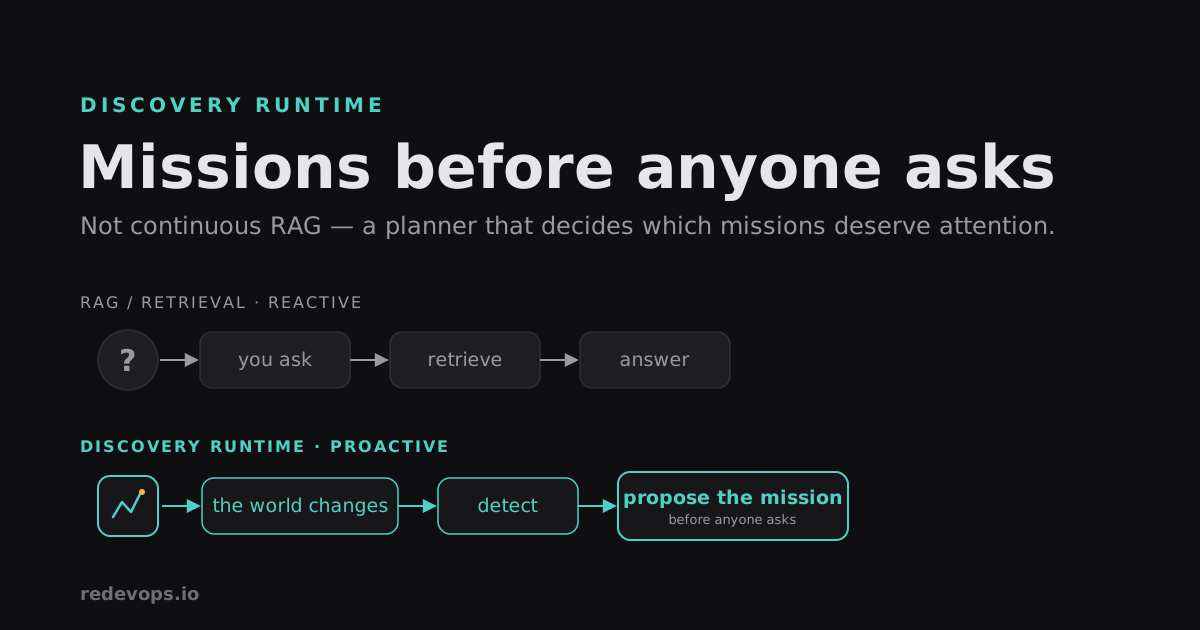
DISCOVERY RUNTIME1/11
The layer that decides which missions are worth running
- Mission Runtime executes a known mission; Context Runtime answers a known question. Both assume someone already decided what deserves attention.
- Discovery Runtime removes that assumption. It watches the evolving world state, detects meaningful change, and proposes the missions worth running — before anyone asks.
- It sits above the query planner: the step that decides a plan should be produced at all.
FROM DASHBOARDS TO MISSIONS2/11
Dashboards describe. Discovery decides what deserves attention.
- Most analytics is reactive: a person notices something, asks a question, waits for a chart, then decides.
- A dashboard says what happened. Discovery Runtime says what changed, why it may matter, and what to investigate or do next.
- The output is not another alert — it is a proposed mission: a
MissionProposalcarrying a sealed intent, a rationale, the evidence that made it worth raising, a priority and an expected-value note (contract). The priority is an argument, not a permission — Mission Runtime decides what is admissible to execute.
SIGNALS3/11
The perception layer: normalized signals over the world state
- A Signal is a normalized observation from any system — SQL, events, logs, CRM, a property graph, sensors, or a Mission Runtime outcome.
- A bounded per-series history (subject × metric) is the world state the detectors read.
- Adapters translate source-specific events into signals; everything downstream speaks one language.
DETERMINISTIC FIRST4/11
Deterministic detectors first, AI only where it earns its place
- Most detection is cheaper done deterministically: thresholds, rate-of-change, EWMA forecast residuals, weekday-seasonal baselines, peer-group deviation, data-freshness, property-graph change.
- No LLM call per metric update — Discovery scales with change, not with the size of the world.
- Reasoning becomes useful only after a meaningful pattern is detected.
SUPPRESS + CORRELATE5/11
Seven missions, not ten thousand alerts
- Suppression collapses repeats, active incidents and cooldowns; correlation (noisy-OR) groups co-moving symptoms into one discovery.
- Example: conversion down 18% in Region South, concentrated in SKUs with fulfilment delays — three signals become one investigation, not three alerts.
- The whole point: a small ranked set of things worth a human's attention.
HYPOTHESIS + EVIDENCE6/11
Evidence-backed hypotheses, not free-form guesses
- Each correlation becomes a hypothesis with supporting and contradicting evidence and a verification plan — plus two kinds of provenance kept separate: origin (what triggered the mission — carried as
source+originon the compiledMissionProgram) and the epistemic record of each input (on a sealed intent every value records its author — user, model, reader, policy or declared default — and its supporting evidence, and anything readers disagreed on stays an open question rather than being averaged away). Conflating them launders a guess into a fact; keeping them apart lets a mission report not just what it did but how sure it was. - Context Runtime is asked for the right representations — SQL trend, temporal history, property graph, recent complaints, deployment events.
- The default planner is deterministic; an LLM planner is injectable when the pattern warrants it.
PROPOSALS7/11
Ranked by decision value, with a risk-aware policy
- A scorer ranks proposals by expected business value, confidence and urgency — not by alert recall.
- A policy decides the disposition: ignore · monitor · request-evidence · propose · auto-launch.
- Read-only investigations may auto-launch; anything with consequences is proposed for a human.
GOVERNED HANDOFF8/11
A proposal becomes a governed mission — never a silent action
- Approved proposals cross a bridge into Mission Runtime — approvals, budget, replay, evidence ledger, saga rollback — and become ordinary missions: a discovered mission and a human-authored one validate, simulate, run, replay and verify identically, one compiler over three sources (human · application · discovery), differing only in that recorded provenance. No privileged path skips validation.
- Discovery proposes and explains; Mission Runtime governs and persists. Discovery never independently takes high-impact action.
- A proactivity budget bounds how much autonomy the stream of proposals may exercise before a human is required.
NOT CONTINUOUS RAG9/11
It is not another retrieval system
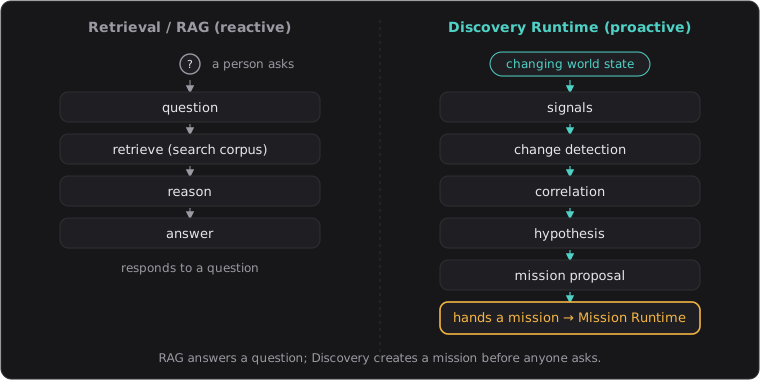
- The easy misread is "continuous RAG" — retrieval on a loop. It is not.
- RAG answers a question you already asked. Discovery Runtime decides which questions and missions deserve attention in the first place.
- Retrieval is something a mission uses once it exists; Discovery decides a mission should exist at all.
IT LEARNS10/11
It learns which signals and hypotheses are worth promoting
- Every proposed mission produces feedback: was it valid, did a human accept it, did the action improve the outcome, what did a false positive cost?
- Open source today:
discovery_runtime.learnturns experience into candidate lessons — a correction is not a rule. A pattern must clear a promotion policy (Wilson lower-bound confidence) and a review/shadow stage before it becomes a lesson (learn.py). - Over time the runtime learns which signals, correlations and hypotheses matter per business regime (the per-regime signal learner is part of the enterprise reference implementation; the open lesson lifecycle is below).
- The objective is maximum decision value, not maximum alert recall.
EFFICIENCY + WHERE IT SITS11/11
Recompute only what changed — and where it fits
- StateDelta recomputes only the series that changed; ActivationBudget activates only the relevant detectors, representations and models — MoE at the level of infrastructure, not weights.
- Incremental Discovery (open source,
discovery-runtimev0.1.x). A typedEvidenceChangedelta plus a version-aware checkpoint{evidence_position, policy_version, capability_set_version}re-derive only the affected conclusions: a conclusion goes STALE (re-evaluate) when an evidence it relied on was updated — or the policy/model version moved (rediscovery fires even with no source change) — and INVALIDATED (basis gone) when one was deleted; the rest stay verified, untouched. Benchmark B: the incremental path reaches the same valid outcome as a full rescan touching far less (fewer records / model calls / bytes) — pinned by tests in the public repo (incremental.py,test_benchmark_b_*). - Evidence identity survives the handoff. A versioned, content-addressed
EvidenceRef(runtime-contracts) crosses the Discovery→Mission boundary (and mission replay) intact: the mission records the sealed intent’s content hash and evidence refs, binds aContextEpoch, andrehydrate()fails closed if replay cannot reproduce them — so a decision pins exactly which evidence revision it used. - What is open and what is not. Open source: the intent-discovery side — draft → fuse → clarify → seal, incremental re-derivation and the lesson lifecycle (discovery-runtime), exposed to Agentic OS apps through
agentic_os.discoverytogether with a generic, domain-neutral detector shell (DetectorDiscoveryRuntime). The full signal engine described on slides 3–7 — detector library, noisy-OR correlation, ranking policy, proactivity budgets,StateDelta/ActivationBudgetrecompute — is the enterprise reference implementation and is not in the public repositories. - Three runtimes, three questions: Discovery — what deserves attention; Context Runtime — which evidence and representations; Mission Runtime — how to execute safely.
- Live in the Projects operating console: every domain tile reads a Discovery queue; the attention queue ranks proposals across domains.