Self-Learning Insurance Distribution: A Governed Control Loop, Not a Pitch Generator
Most "AI for insurance distribution" is a rules engine: map a customer profile to a canned pitch and send it. That's wrong at the root. Which action wins depends on evidence that changes over time; the reward arrives weeks or months later; several objectives pull against each other; and many actions are simply not allowed to a given producer for a given customer in a given state.
So we built a self-learning distribution control layer, a durable loop that reuses three runtimes we already ship, plus a contextual bandit, under governance:
discover -> contextualize -> constrain -> choose -> execute -> verify -> learn
Every stage is auditable.
The loop, stage by stage
1. Discover the opportunity class. Discovery Runtime names an opportunity class (a coverage gap, a renewal at risk, a carrier-appetite mismatch, a cross-sell, or a compliance change that forces action), which keeps the loop learnable and explainable.
2. Contextualize. Context Runtime assembles a versioned DecisionContext: policies, quotes and claims; CRM history; renewal dates; carrier appetite; producer and agency performance; household, ownership and beneficiary relationships; and consent, licensing and suitability state. Every element carries provenance, freshness, confidence and policy labels, so it can be replayed against the exact evidence that produced it.
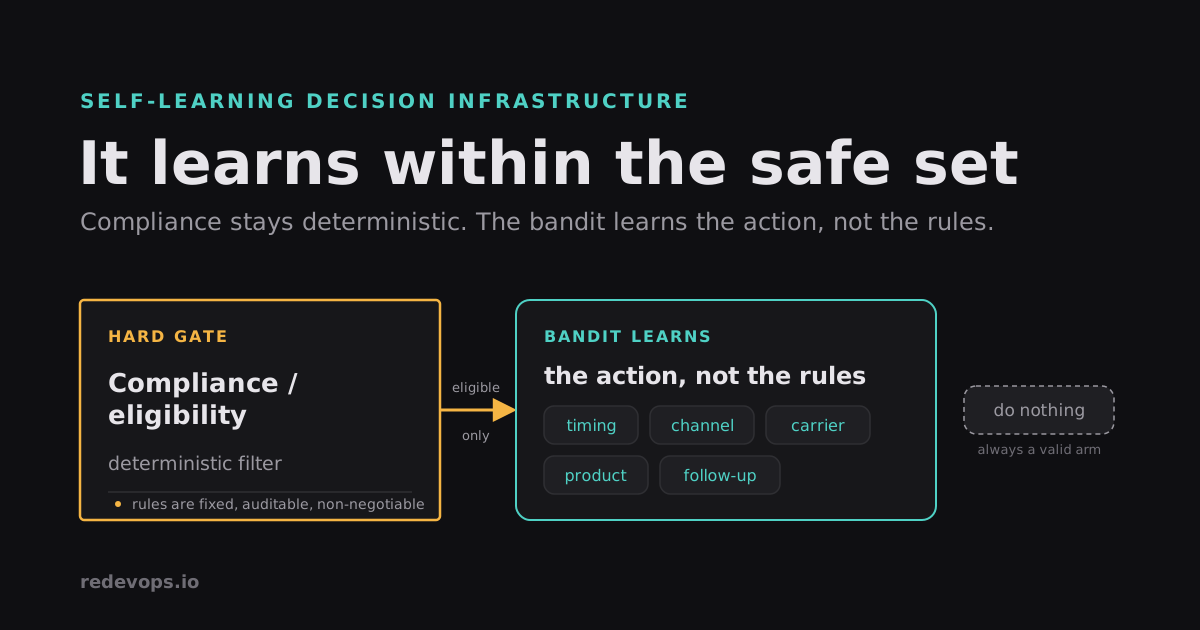
3. Constrain: before any learning. Deterministic eligibility and compliance pruning removes unsafe or prohibited actions before the learner ever sees them: producer licensing, customer consent, carrier appetite, underwriting eligibility, suitability and replacement rules, state regulation, approved products and messages, contact-frequency limits, fairness and anti-discrimination constraints, and budget or authority limits. Only the surviving safe candidates reach the bandit: compliance is a hard filter on the action set that the model cannot trade away.
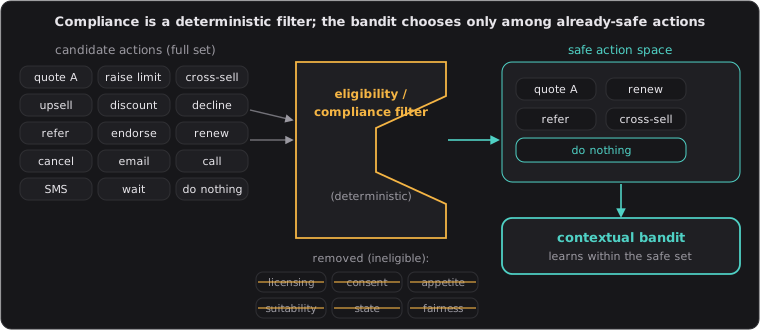
So the runtime does not learn compliance. The bandit chooses only among already-safe, legal actions, and learns strictly within that space: timing, communication and message strategy, channel, escalation path, carrier, product and package, and follow-up cadence, self-learning decision infrastructure.
4. Choose a composite action. The action is a tuple:
product x carrier x package x timing x channel x
message-strategy x broker-involvement x follow-up
plus governed low- and no-ops: request more information, route to broker review, defer, monitor, and an explicit DO NOTHING arm. Doing nothing is first-class: a system that cannot choose it will always find a reason to act.
5. Learn from delayed, multi-objective reward. The contextual bandit chooses among the safe candidates, keyed on the business regime (opportunity class x segment x risk band). Positive reward components include bound value, retention, persistency, acceptance and coverage-gap reduction; negative ones include complaints, opt-outs, quote abandonment, underwriting rejection, early cancellation, compliance violation, producer effort, operational cost and downstream claims. Raw components are kept for audit, but only the single terminal reward trains the policy, so the model optimizes the objective the business actually cares about.
6. Verify and act under governance. Mission Runtime executes the chosen action with approvals, verification, replay and audit, producing a full EXPLAIN of the decision: the opportunity, the evidence used, the pruned candidates and why, the winner's ranking, the approver, the outcome, and how it fed back into learning.
Prove it offline before you act live
We do not turn a fresh policy loose on real customers. Offline first: inverse-propensity scoring (IPS / SNIPS) estimates a learned policy's value counterfactually from logged decisions, compares it against the current business policy, and gates on effective sample size. If the data cannot support a confident estimate, the gate stays shut. Only when the estimate favors the learned policy does it move to shadow mode (decide, but do not act), then a controlled live pilot: live exploration last.
v8 efficiency and governance primitives
The loop inherits the primitives that keep the wider stack cheap and honest:
- Delta-driven processing: recompute only what changed in the
DecisionContext. - Sparse capability activation: an
ActivationBudgetcaps how much machinery any one decision lights up. - Routing-health and anti-collapse metrics: selection entropy, action exposure, capability concentration, effective sample size and fallback frequency, so you can see a policy collapsing onto one arm before it does damage.
- A proactivity budget: Mission Runtime governs how much autonomy the loop may exercise.
The benchmark: InsuranceDistributionBench
No public dataset has the full shape this loop needs: a composite action, a delayed multi-objective reward, and a logged propensity for every historical decision; that data lives inside carriers' systems. So InsuranceDistributionBench is synthetic and deterministic. It proves the loop is correct end to end, with no commercial performance claim:
- Discovery precision: the right opportunity classes surface.
- Policy-pruning correctness: a prohibited carrier or product never becomes eligible, no matter what the reward signal suggests.
- Fairness enforcement: a fairness-blocked account is left with only the governed floor of actions.
- Learned-vs-baseline lift: the bandit converges to a strongly-matching arm and beats the do-nothing baseline.
- Off-policy value: SNIPS favors the learned policy over the logged one.
A deterministic environment verifies mechanism, no market performance. To get closer to reality, several public datasets can seed distributions and validate the estimator, each used only to benchmark the runtime, never redistributed or embedded in a customer deployment:
- Health Insurance Cross-Sell Prediction (Kaggle), non-commercial license.
- UCI COIL 2000 / TIC (CC-BY-4.0), non-commercial research only.
- French MTPL
freMTPL2(CASdatasets, GPL), research use. - Open Bandit Dataset (ZOZO, CC-BY-4.0), to validate the IPS / SNIPS estimator against real logged propensities.
They confirm the off-policy estimator behaves on genuine propensity logs but do not let us claim distribution performance. A real carrier's historical book is required before any performance claim, and a live pilot is a later, gated phase.
Where it sits in the stack
A composition of three runtimes, each doing what it already does:
- Context Runtime decides how to answer: assembling the versioned, provenance-tracked
DecisionContext. - Mission Runtime decides how to act: executing under approvals, verification and replay.
- Discovery Runtime decides what is worth acting on: surfacing opportunity classes.
Composed, they form a governed, self-learning distribution loop that explains every step to the person (or regulator) who asks.
#Insurance #InsurTech #ContextualBandit #ReinforcementLearning #OffPolicyEvaluation #AIGovernance #Compliance #AIInfrastructure #LLMOps #MissionRuntime #ContextRuntime #DiscoveryRuntime #GenAI #DecisionIntelligence