Rent Today's Compute. Buy Tomorrow's.
AI compute is improving so fast that waiting may be one of the highest-return infrastructure decisions a company can make.
In 2016, the supercomputer behind AlphaGo cost on the order of $35 million to build. By 2022, a single NVIDIA H100 delivered broadly comparable compute. The mapping is approximate (Go search and LLM inference are different workloads), and the economic point is: capability that once filled a room had collapsed into one accelerator. By 2025–26, NVIDIA's rack-scale NVL72 packs 20–30× an H100's performance into a single 42U rack for roughly $6.5 million.
Read those three points as a curve: in about a decade, useful AI compute per dollar rose by more than two orders of magnitude, and it is still moving.
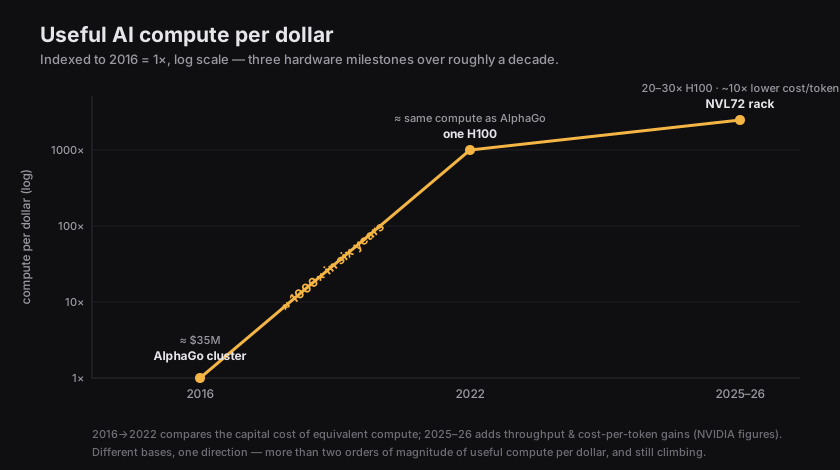
That is the whole investment argument. If performance-per-dollar can change this radically inside the economic life of the hardware, buying compute too early can destroy capital even when you are exactly right that demand will explode.
The wrong equation
The usual buy-vs-rent question is "how many months of cloud rental equal the purchase price?" For AI, the better question is "what will the same capital buy two or three years from now?"
Spend $10M today to dodge $15M of rental and you've booked a $5M saving, and locked yourself into today's silicon. Rent instead and you've bought something else: an option on the next generation. Renters consume computation; owners consume computation and absorb technological depreciation.
The worst moment to own
And this is a bad moment to hold that depreciation. RAM, SSDs, CPUs and GPUs are all expensive and getting more so as AI demand soaks up HBM, DRAM and NAND. The counterintuitive part: the higher those input prices climb, the better "rent now, own later" looks: you're paying a scarcity premium for hardware that will be second-tier before the bill is paid.
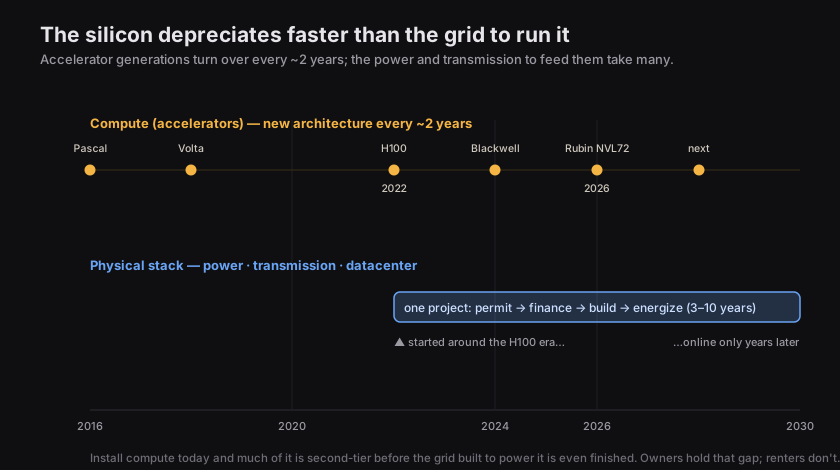
Meanwhile the physical stack (power, cooling, substations, transmission, fiber) moves far slower than the chips. NVIDIA can ship a new architecture every couple of years; a transmission line or a power plant takes many. So the silicon you install depreciates faster than the grid built to run it.
Let the big dogs fight
Notice who is buying anyway. AWS says its AI capacity is effectively fully booked, so it has to keep pouring capital into expansion despite outrageous current prices. That is a hyperscaler with a full order book defending market share. And the forced buyers are exactly the players who can aggregate demand across customers, keep utilization high, finance at scale, and rotate through hardware generations while reusing the long-lived layers (the buildings, power, cooling and fiber) as the short-lived compute layer turns over.
For almost everyone smaller, the move is the opposite: stay on the sidelines while the giants fight for share. FOMO is not an investment thesis. Rent while compute is improving fastest, preserve capital while inputs are scarce, and let specialized owners absorb the utilization and obsolescence risk, then buy a later generation with dramatically more compute per dollar.
In a normal market, waiting means giving up capacity. In an exponential compute market, waiting may buy you more of it. The biggest mistake in AI infrastructure is probably buying the right amount three years too early.
Notes: AlphaGo's largest published configuration used 1,202 CPUs and 176 GPUs; the $35M build cost and H100 equivalence are economic approximations, not a literal benchmark. The NVL72 rack figure is a third-party estimate ($5–9M depending on configuration; ~$6.5M used here). "20–30×" tracks NVIDIA's own NVL72-vs-H100 inference claims on specified workloads. The "wait" view is an investment thesis, not a forecast.
redevops.io builds rAIlsApps (source-available (AGPL-3.0 with the Commons Clause)): self-hostable modules run by agents, on hardware you can actually afford.