ADK Delegates Across a Mesh. ReDevOps Keeps Authority Narrowing.
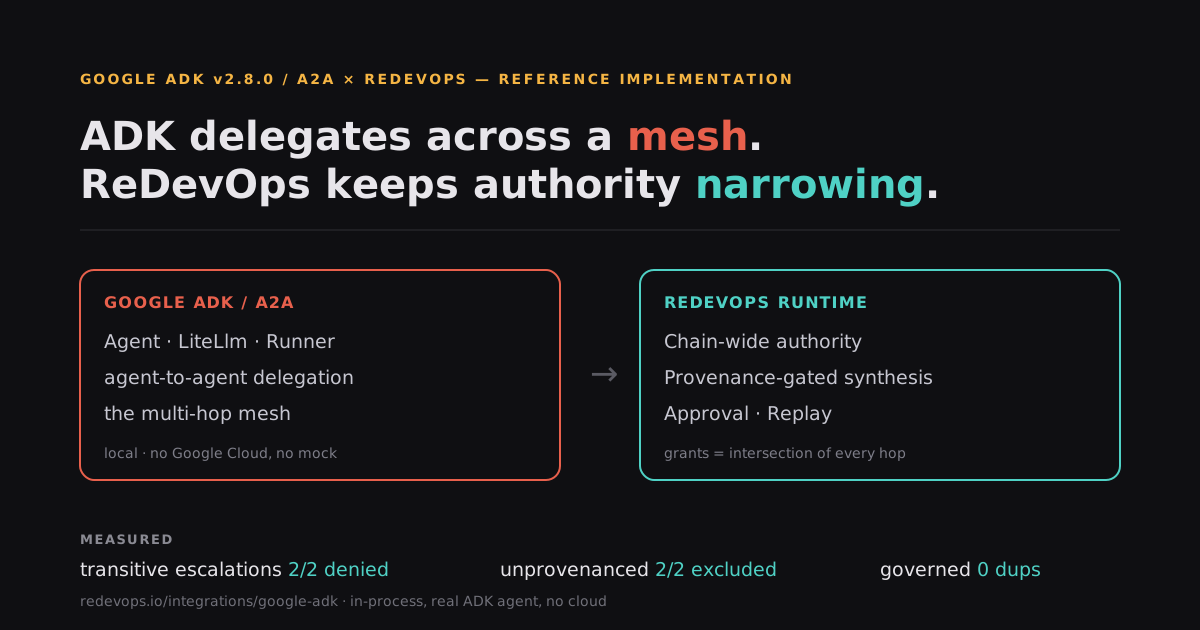
The CrewAI slice earlier in this series established a rule for delegation: a delegated agent's authority is the intersection of the chain, so it can only ever narrow. Google's Agent Development Kit and the A2A protocol raise the same question at a larger scale (agents delegating to other agents across service boundaries, sometimes several hops deep) and that scale surfaces failures a single in-process crew never shows. So this slice tests what only a multi-hop mesh breaks.
It also runs entirely locally. Google ADK is open source; its agent loop runs in-process, and with LiteLlm it points at any OpenAI-compatible endpoint. Installing google-adk[extensions] and a2a-sdk didn't even disturb the shared benchmark environment: pydantic, numpy and torch stayed put, and a real ADK Agent runs alongside the NeMo, PydanticAI, LlamaIndex and CrewAI slices in one venv. No Google Cloud account was used anywhere below.
The two failures unique to a multi-hop mesh
Picture a research mesh. A coordinator holds three grants: read research, fetch the web, write the shared knowledge base. It delegates to a web-researcher agent that only needs to read and fetch, so it drops the KB-write grant. That agent delegates again, to a scraper. And here is the failure: the scraper, configured independently, re-declares a KB-write capability. In a raw A2A mesh, it would run with its own capabilities, and it would write the KB, a grant the coordinator's own delegation had already dropped, now silently back three hops later.
ReDevOps closes this by making effective authority the intersection of the whole chain across every handoff. Once the web researcher dropped KB-write, no downstream agent can regain it, no matter what it declares. In the benchmark, the scraper's attempts to write the KB and to delete are both denied (two transitive escalations, zero wrong calls) while its legitimately-scoped fetch, and the web researcher's read, are admitted. Authority is monotone non-increasing across every hop.
The second failure is about trust in what comes back. A coordinator synthesizes an answer from the findings its delegates return. But which agent actually produced a given finding, and was it an authorized one? In a raw mesh, the coordinator trusts the return value. ReDevOps requires a provenance chain: a finding enters the synthesis only when every agent in its chain is a known, authorized mesh agent. A finding relayed by an unknown agent, or arriving with no provenance at all, is excluded: both kept out in the benchmark, where a raw mesh would trust both.
The mesh still does the research
None of this is hypothetical plumbing around a mock. A real google-adk agent answers the delegated research sub-questions end-to-end (four of four) and ReDevOps attaches a provenance chain to each, so all four findings are attributable back to authorized agents. ADK keeps owning the agent loop and the delegation; what ReDevOps adds is the property a multi-hop mesh needs and cannot carry on its own: authority that only narrows, and answers you can attribute.
And, as in every slice, the consequential action is governed separately. When a delegated finding is written into the shared KB other agents rely on, that write runs only through a Mission: no authority, no write; no approval, no write; approved, exactly once; replayed after a crash, zero duplicates.
The full GO-A…GO-E result matrix, the frozen environment, and the acceptance-bundle hashes are on the benchmark page, and the code (a real google-adk agent, local, no Google Cloud) is on GitHub. Same provider-neutral contract as the NVIDIA, PydanticAI, LlamaIndex, CrewAI and Azure slices; new provider support is a conformance exercise on the same architecture.