From AI Runtime to Standalone Applications: The ReDevOps v0.6.1 Release
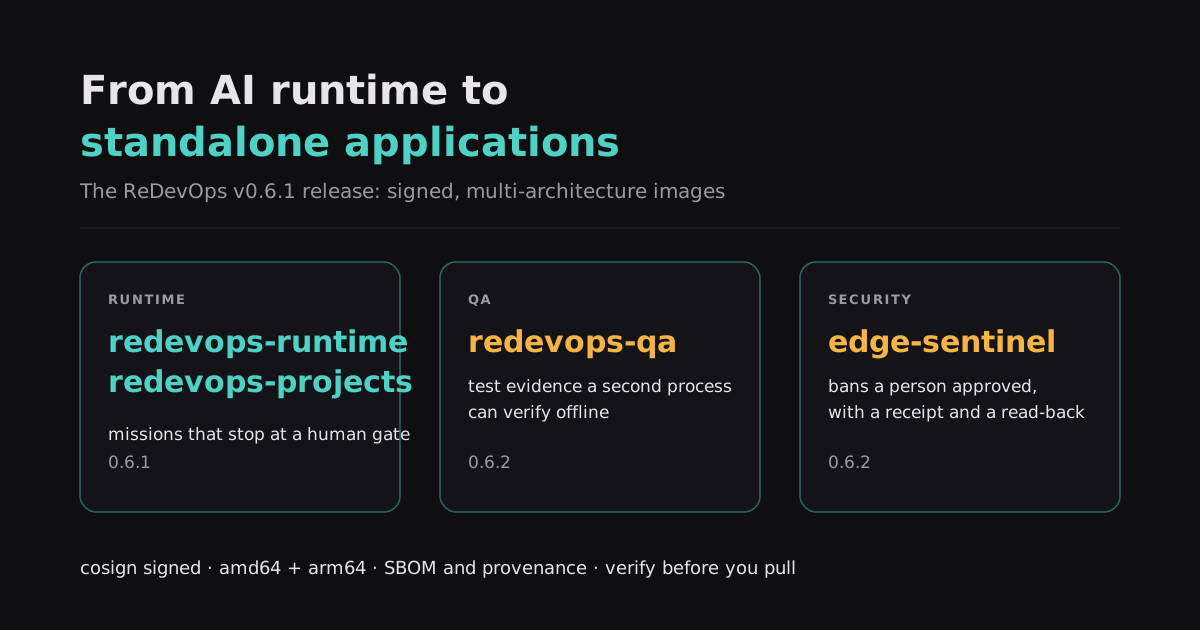
Two problems come up again and again once AI starts doing real work: you cannot show afterwards what was checked, and you cannot show who allowed what happened. This release is about making both answerable, and about letting you install the parts without installing everything.
Two questions nobody could answer afterwards
A test run passes. Three weeks later someone asks what that pass was based on. The log says "ok". The browser version is gone, the assertions may have been edited since, and the only way to find out is to run it again and hope.
A security tool bans an address at 03:12. In the morning someone asks who approved it and what the tool actually saw. The answer is a line in a log that the tool wrote about itself.
Both are the same problem: the system acted, and the record of why is written by the thing that acted. The ReDevOps runtime exists to separate the two. Missions stop at a human gate, grants are checked before an action, and the evidence is kept in a form that a second party can check. v0.6.1 is the release where that runtime, and two applications built the same way, can be installed from signed images in a few commands.
What is in the release
| Product | What you get | Reference |
|---|---|---|
| rAIls runtime and Projects | Two container images, redevops-runtime and redevops-projects, tag 0.6.1, linux/amd64 and linux/arm64. | ghcr.io/redevops-io/redevops-runtime@sha256:9d5cb6aef88a136eae8d0bfac3b92ca9edc06c972026ceb07d0e0a6abcacf32e, ghcr.io/redevops-io/redevops-projects@sha256:616633b471afb3fe222f2766f9f7cdebed9b9c4c5174bd0b9b8e1a68d356f971 |
| Desktop distribution | Signed installers: macOS (notarized and stapled), Windows (MSI and setup, signed launcher, sidecar and uninstaller), Linux (.deb and AppImage, covered by a signed manifest). | GitHub release v0.6.1 |
| redevops-qa standalone | The QA runner and a small authenticated HTTP service in one image, tag 0.6.3. | ghcr.io/redevops-io/redevops-qa@sha256:54d8064caef7e9798bff2009c841103a37451ecd4e7fc9f1cbf44c9bf8dff779 |
| edge-sentinel standalone | A security-operations dashboard and API over a CrowdSec core, tag 0.6.4. | ghcr.io/redevops-io/edge-sentinel@sha256:a89cff83c0ceb523530bdd7ee1dbe42da46b553d885d4416969fbbc569e2b6ce |
| Full rAIlsApps stack | The applications running on the runtime. Not a new image in this release: edge-sentinel is one of those apps, and its standalone image keeps the same routes and environment variable names. | Repository |
The two standalone images are numbered ahead of 0.6.1, not level with it, on purpose. Each is rebuilt independently from main whenever a change lands that the standalone image should carry, and a version label that implied otherwise would misdescribe the release. edge-sentinel is now at edge-sentinel-v0.6.4 (commit 4b1f80fd84ef), which adds the runtime-exposure scanner covered below; redevops-qa is a separate repository, currently at v0.6.3 (commit 9e495bdf31a7), a documentation and report-rendering update over 0.6.2. The v0.6.1 images and installers are exactly what was published and are not rebuilt.
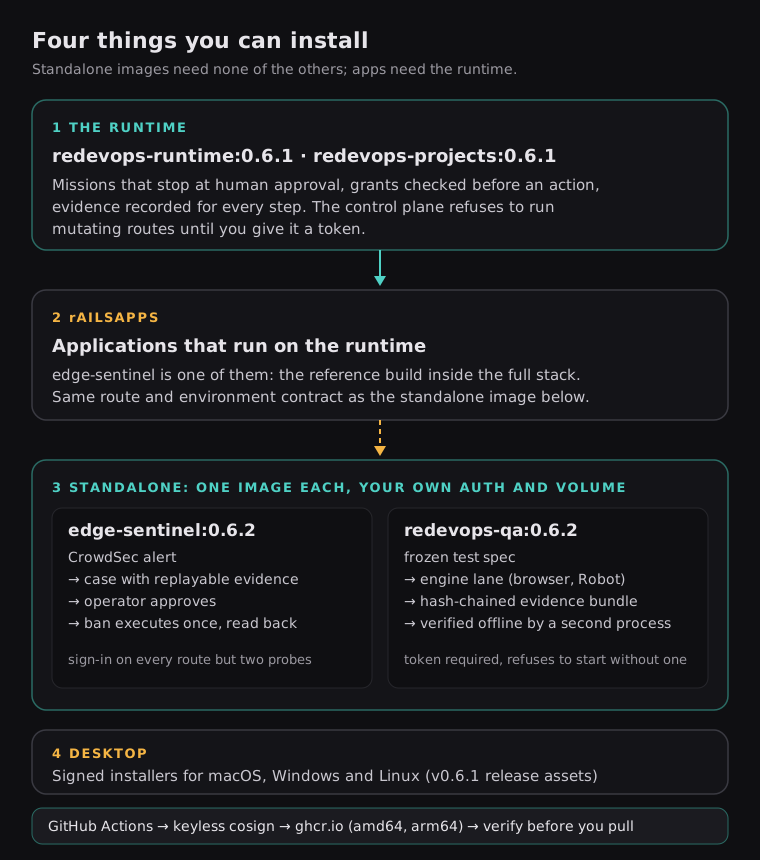
How the pieces relate
The runtime is the governed core: missions, grants, approvals and recorded evidence. rAIlsApps are applications that run on it. A standalone image is one application packaged so that it needs none of the rest: its own authentication, its own volume, its own health checks. The desktop installers carry the same line to a workstation.
redevops-qa is the odd one out, and worth saying plainly: it does not run on the runtime image. It shares the qa/v1 schemas and the pinned harness with the rest of the project, and nothing else, which is why it could be packaged on its own without touching anything above it.
redevops-qa: a test result you can check again
redevops-qa runs a frozen test specification through an engine lane (a Playwright browser lane, a Robot Framework lane) and writes an evidence bundle: every artifact hashed, the hashes chained. A second process, the verifier, then re-derives the verdict from the recorded observations and the frozen assertions. It does not trust the engine's own pass or fail.
What we ran against the published configuration:
- A browser run against the fixture app ended
VERIFIED. - A run with a seeded defect (the fixture app has deliberate ones) ended
FAILED, exit code 1, and its evidence bundle was still accepted byverify: the failure is as well documented as a pass. - The downloaded bundle was verified in a second container started with
--network none. - Runs survived a container restart and a
downandup. - On a native Linux runner, with the image's seccomp profile, no capabilities and no new privileges, the Robot lane ran with its kernel egress layers and produced the same three outcomes through the service API.

The static HTML report of a run with a seeded defect. The page lists what the verifier checked, one assertion that failed and two that held, and says what the verdict does not prove.
The limits matter as much as the features:
- It runs against its bundled fixture app only. Pointing it at your own application is design work that has not shipped.
- There is no web application. The product never had one. The only HTML it produces is the static report above. The image adds a small HTTP service (start a shipped plan, read status, download the report and the bundle) so that it can be deployed and probed like anything else; it refuses to start without a token, serves
/healthzand/readyz, and has no way to name a target or a path. - The arm64 image is partial. The product's bundle and browser pin are linux x86_64 only, so on arm64 you can verify, report and inspect evidence made elsewhere, but the lanes report that they are unavailable and say why.
- The image carries Playwright with Chromium and Robot Framework. Selenium and Appium are not in it.
edge-sentinel: a ban someone approved
edge-sentinel sits on top of CrowdSec. CrowdSec detects; edge-sentinel reads its alerts and decisions over the CrowdSec local API and turns each alert into a case with content-addressed evidence and a replay proof: the same alert always becomes the same case. For critical and high alerts it proposes a ban. A signed-in operator approves or rejects, and only an approved action can execute, once, returning a receipt and a read-back from CrowdSec that confirms the ban exists.
As of 0.6.4, the same chat interface also runs two more kinds of security work, each going through the same stage-then-approve-then-record path as a CrowdSec ban: the existing Trivy/Syft supply-chain scanner (SBOM, vulnerability list, malware scan), and a new runtime-exposure engine — nmap service-version detection against a host, plus read-only Kubernetes checks for over-privileged RBAC bindings, namespaces with no NetworkPolicy, privileged or hostPath/hostNetwork pods, and ServiceAccount token over-exposure. The exposure engine runs as a separate process the operator starts alongside edge-sentinel, pointed at infrastructure the operator already holds credentials for (SCAN_ALLOWLIST names exactly what it may reach); it is not bundled into the standalone image and is not reachable from the public demo chat.
What we ran from the published image, from a fresh install with a clean Docker configuration and nothing cached:
- Every route except the two probes answers
401without credentials, and so does a wrong password. - An alert became a case; replaying it produced the same proof; an anonymous attempt to execute was refused.
- The approval was recorded under the signed-in name, execution returned a
SUCCEEDEDreceipt, and the ban was verified by reading CrowdSec back. - After a container restart the case was still
CONTAINEDwith its decision.

The dashboard from the published image, signed in. The alerts were seeded with cscli using documentation addresses, and the banner says so. The organisation name shown is the shipped default; set SENTINEL_TENANT to your own.

Real bans are off until you set SENTINEL_BLOCK_ENABLED=1; before that, execution is a recorded dry run. The limits:
- Detection is CrowdSec's. edge-sentinel does not read your logs; point CrowdSec at them.
- There is one shared operator credential over HTTP Basic, no per-user accounts or roles, and it belongs behind TLS.
- The hunting, AI-security, agent-event and SOC 2 modules exist in the repository as libraries with tests but are not wired to any route in this release, so there is no API for ingesting an agent event or a log batch.
- The runtime-exposure engine was verified against real
nmapand a real (disposable,kind) Kubernetes cluster with deliberately-insecure fixtures, but not yet against a production cluster — that still needs an operator to populateSCAN_ALLOWLISTfrom a machine with network access to it. - The NetBird, Portabase, Wazuh and ClamAV panels need those services and were not exercised against live ones.
- One replica, because state is a file on a volume. Kubernetes was verified on a throwaway kind cluster; k3s itself was not used.
Run either one on its own
Each product has an install path that needs only its own files. For edge-sentinel on one host:
git clone https://github.com/redevops-io/agentic-os.git
cd agentic-os/deploy/standalone/edge-sentinel
./bootstrap.sh          # random credentials into ./secrets, starts CrowdSec and edge-sentinel
# dashboard on http://127.0.0.1:8203/, user: operator, password: ./secrets/operator_password
For redevops-qa, copy compose.yaml and .env.example from deploy/standalone/ in the redevops-qa repository, then:
cp .env.example .env && chmod 600 .env
openssl rand -hex 32     # put this after QA_SERVICE_TOKEN= in .env
# set QA_IMAGE_TAG=0.6.3 in .env
docker compose up -d --wait
Both publish on 127.0.0.1 only; Compose refuses to start without the secrets, and the Kubernetes manifests (a kustomization for each) apply a default-deny network policy and run as an unprivileged user with a read-only root filesystem. The full guides: edge-sentinel and redevops-qa.
Verify before you pull
Every image is built by GitHub Actions from a tag, signed keyless with cosign, and carries a provenance attestation and an SBOM. Reference the digest, not the tag, and check it first:
cosign verify ghcr.io/redevops-io/edge-sentinel@sha256:a89cff83c0ceb523530bdd7ee1dbe42da46b553d885d4416969fbbc569e2b6ce \
  --certificate-identity 'https://github.com/redevops-io/agentic-os/.github/workflows/oci-edge-sentinel.yml@refs/heads/main' \
  --certificate-oidc-issuer https://token.actions.githubusercontent.com
gh attestation verify oci://ghcr.io/redevops-io/edge-sentinel@sha256:a89cff83c0ceb523530bdd7ee1dbe42da46b553d885d4416969fbbc569e2b6ce --owner redevops-io
The runtime images verify against oci-release.yml, redevops-qa against its own repository's oci-release.yml. The desktop installers carry their platform signatures (Apple notarization, Authenticode with a timestamp) and are listed with their hashes in release-manifest.json, signed with a published release key; the release notes give the exact commands.
Two builds of the same runtime commit produced identical per-architecture image digests in our rehearsal; the multi-arch index digest differs between builds because the provenance attestation inside it records the build. We rely on the signed index digest as the identity of a release.
What we found while releasing
Releasing in the open means the awkward parts show up too:
- A signing hand-off that failed silently. The helper that passes files from the Windows installer build to the signer rejected the NSIS uninstaller's temporary file name, and the build carried on and shipped the uninstaller unsigned. We found it in a rehearsal, signed the uninstaller through a wrapper for this release, confirmed with an install check that every installed executable is validly signed, and a fix with a regression test that runs a real NSIS build is in review.
- Two lines of history. The desktop release line and the main branch of the repository have diverged, which is why edge-sentinel carries its own tag. Publishing the release line also made the repository's secret scan read old commits it had never seen; four fixture strings tripped it and were allow-listed after we read each one.
- A residual we cannot fix yet. Two HIGH findings in Debian's
zlib1gare fixed upstream, but the currentpython:3.12-slimbase image does not include the fix. We will evaluate and publish updated images when a suitable patched base becomes available. - A CRITICAL we disclose. The redevops-qa amd64 image carries
libxml2(CVE-2026-6653, a denial of service) with no Debian fix yet. The scanners found no secrets in either standalone image, and every vulnerability they report in redevops-qa has no fix available upstream; edge-sentinel's scan shows no findings in its Python packages.
What is not done
- redevops-qa cannot yet test an application of your own, and has no web interface.
- edge-sentinel has one operator credential, no roles, and several panels that need services we did not run.
- The runtime-exposure engine is not wired into either packaged deployment (
deploy/combinedordeploy/standalone) and needs the operator's ownnmap/kubectlreach into infrastructure this repository has no business holding credentials for by default — it runs as a separate process the operator starts and points at themselves. - The standalone images are
redevops-qa:0.6.3andedge-sentinel:0.6.4; the matching install-profile entries in redevops-qa are still marked planned until a documented run is recorded. - The licence is source-available under the family licence (AGPL-3.0-or-later with the Commons Clause). The public licence of the finished products is not final.
Links
- Release notes and installers: github.com/redevops-io/agentic-os/releases/tag/v0.6.1
- Packages: redevops-runtime, redevops-projects, edge-sentinel, redevops-qa, agentic-apps-desktop
- Repositories: agentic-os, redevops-qa
- Earlier on QA: Why We Built One QA Runtime for Multiple Test Engines