The Best AI Swarm Is Usually Smaller Than You Think
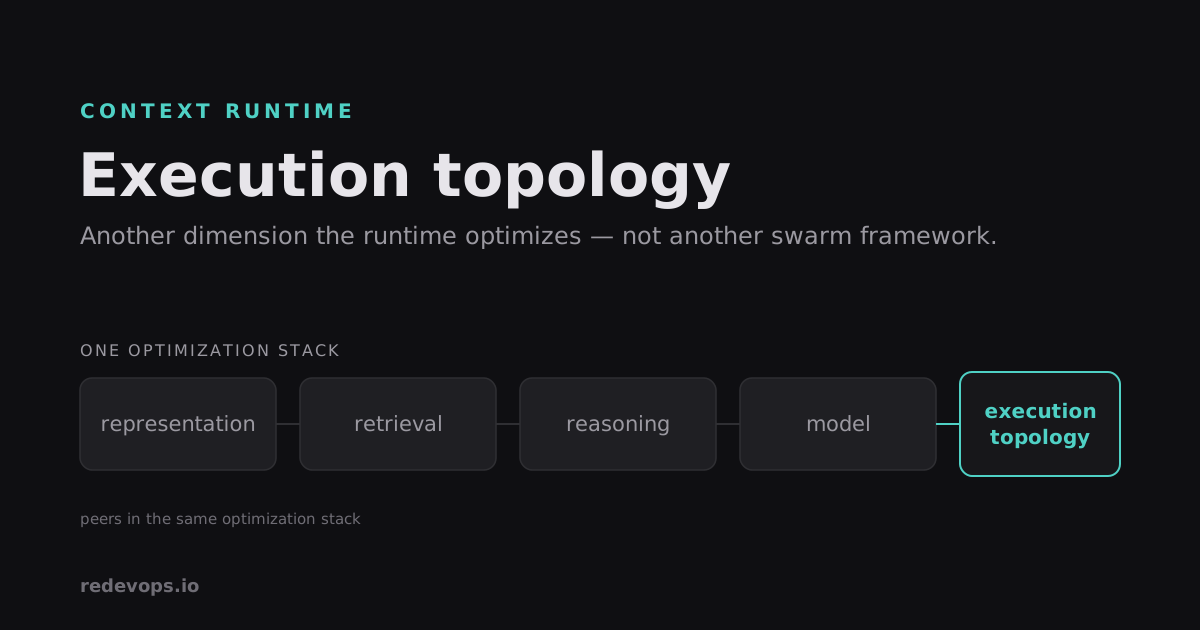
Google DeepMind evaluated hundreds of multi-agent configurations and found the coordination strategy matters more than the number of agents. Teams did well on work that split into independent tasks, but lost to a single capable agent on tightly coupled, sequential work, where coordination overhead and error propagation outweighed parallelism.
This matches how we've evolved Sidekick, Context Runtime and Mission Runtime. The point is that coordination structure is a variable worth optimizing, like the model to call or the retriever to use.
Better than "more agents"
The question is which execution topology fits the task. A coordinator-worker one keeps workers independent, with one component reconciling and verifying their output:
Mission
    ↓
Coordinator
    ↓
Independent workers
    ↓
Merge
    ↓
Verification
    ↓
Commit
Execution topology is an optimization dimension
Context Runtime already optimizes several choices per workload instead of standardizing on them:
- representation: documents, SQL, property graphs, temporal state
- retrieval: which retrieval strategy fits the query
- reasoning: how much reasoning effort to spend
- model: which model is most suitable
- verification: how the result is checked
Execution topology is the next: how the work is organized.
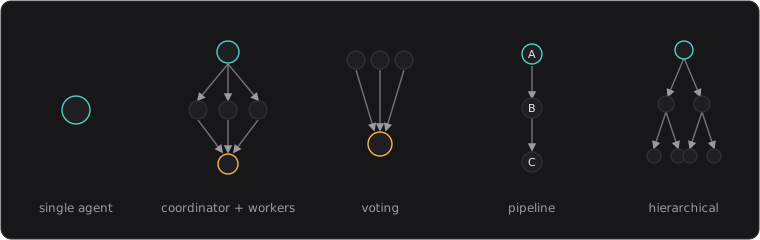
The runtime should learn whether a mission is best run by one agent, a coordinator with workers, a voting ensemble, a pipeline, or a hierarchy, chosen on the task over swarm size. Like the others, it's a cost-based decision weighing quality, latency, cost, coordination and verification overhead, and historical success per mission class.
Not an orchestration framework
LangGraph, CrewAI, Strands and similar tools are orchestration frameworks: you design a graph of agents and they run the topology you already chose. Context Runtime optimizes it instead, choosing the coordination structure for you and learning which wins per mission class. Orchestration runs a chosen topology; optimization decides which to run at all.
Governance stays put: Mission Runtime owns merge, verification, approvals, replay and audit, so a parallel topology is a governed, replayable, accountable mission.
Conclusion
Applications describe intent; Context Runtime should decide what information and models to use and how the work is coordinated: one more measurable dimension. Don't standardize on a strategy; measure the regime, optimize the plan, and learn the best from outcomes.
#ContextEngineering #MultiAgent #AgentOrchestration #LangGraph #CrewAI #AIInfrastructure #LLMOps #AIEngineering #MissionRuntime #ContextRuntime #Agents #GenAI #MLOps #ExecutionTopology