From Dashboards to Missions: Why AI Analytics Needs a Discovery Runtime
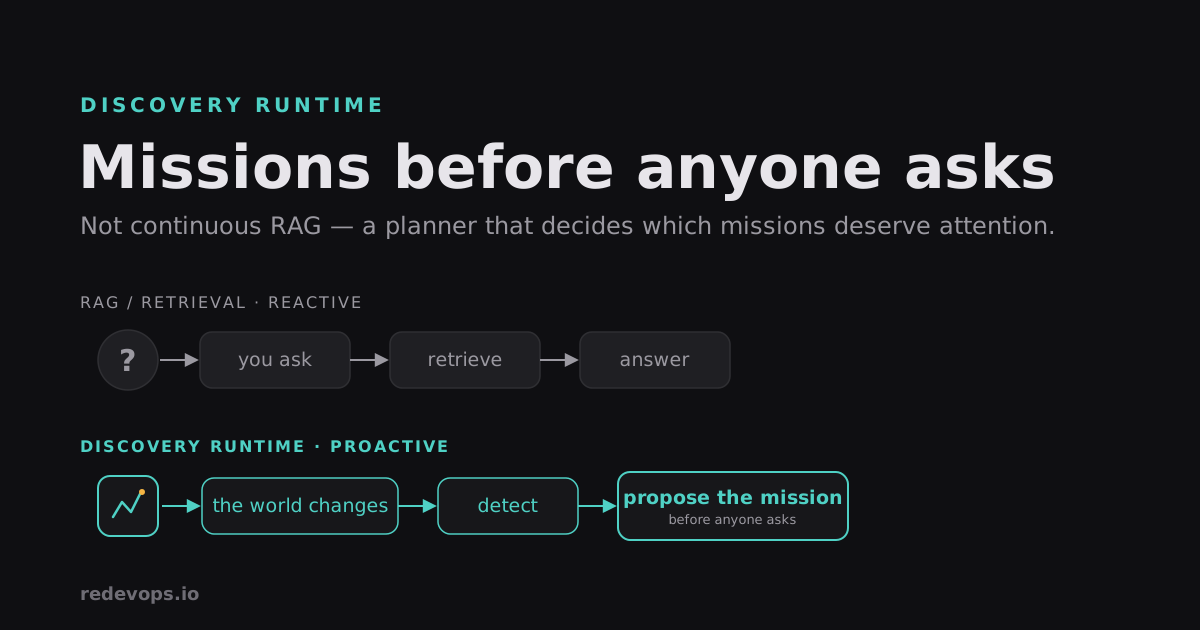
Most analytics is reactive: a leader notices a problem, asks an analyst, waits for a dashboard, then decides. AI eased the query interface but the system still waits. The next generation should answer questions and determine which questions are worth asking.
The missing step before a mission

Context Runtime starts with intent:
Goal → Evidence → Reasoning → Answer
Mission Runtime starts with a mission:
Goal → Plan → Execute → Verify → Learn
Both assume someone already knows what deserves attention. The real pattern begins earlier:
Signals
  ↓
Change detection
  ↓
Correlation
  ↓
Hypothesis
  ↓
Mission proposal
  ↓
Mission Runtime
We call that missing layer Discovery Runtime. Its job:
Observe the evolving business state, identify meaningful changes, and propose the missions worth executing.
Discovery Runtime is not continuous RAG
The easy misread is "continuous RAG": retrieval on a loop. But RAG answers a question you already asked; Discovery Runtime decides which questions and missions deserve attention in the first place, before anyone asks.
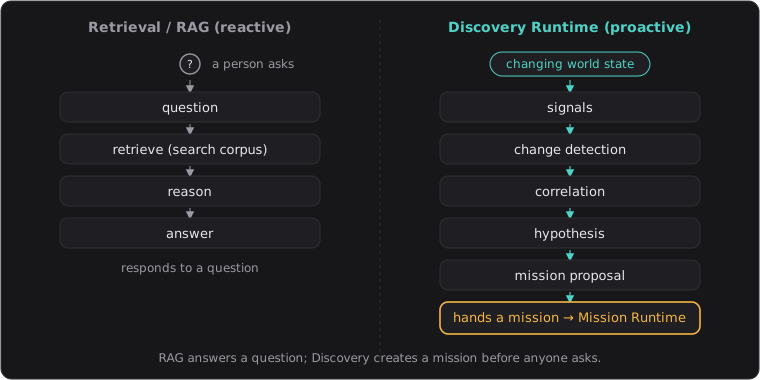
Retrieval is something a mission uses once it exists. Discovery Runtime proposes missions.
Dashboards describe. Discovery Runtime decides what deserves attention.
A dashboard may show revenue declined, support volume increased, inventory availability fell, fulfillment latency worsened, sentiment changed (each chart correct, but a human must still connect them). Discovery Runtime makes them operational:
Conversion in Region South has declined 18% relative to its weekday baseline. The decline is concentrated in products with recent fulfillment delays and low availability. Recommend an investigation mission focused on inventory and delivery performance.
That is a proposed mission with:
- evidence
- confidence
- expected business value
- urgency
- a verification plan
- a recommended workflow
- a policy decision about whether it may launch automatically
Signal detection is not enough
Most monitoring detects threshold violations; the hard problem is deciding whether a change matters. A serious system must handle seasonality, repeated alerts, stale data, correlated symptoms, active incidents, expected changes after deployments or promotions, low-confidence signals, false-positive cost, and competing priorities. The output should turn 10,000 alerts into seven missions: a runtime that suppresses noise, combines evidence, tests hypotheses, and ranks actions.
Deterministic first, AI where needed
Discovery Runtime should not call an LLM for every metric update. Most detection is better handled deterministically by:
- SQL
- thresholds
- rate-of-change rules
- seasonal baselines
- forecast residuals
- graph changes
- time-series models
AI reasoning helps only after a meaningful pattern is detected; Context Runtime then decides which representations are needed, yielding an evidence-backed hypothesis:
SQL trend
+ temporal history
+ property graph
+ recent customer complaints
+ deployment events
Three runtimes, three different questions
Responsibilities separate cleanly:
Discovery Runtime
Should a mission exist?
Mission Runtime
How should the mission execute safely?
Context Runtime
Which evidence, representations, models, and reasoning methods should the mission use?
Sidekick supervises the integrations and operating environment; Projects gives the operator one place to review discoveries, approve missions, and inspect evidence.
Example: proactive business analytics
A real-estate platform observes lower lead conversion in one market, rising days-on-market, higher price-reduction frequency, and increased support contacts, with no change in ad spend. Instead of five charts, Discovery Runtime correlates them and proposes to investigate whether listing-price recommendations have drifted from local market conditions. Mission Runtime then executes a governed workflow:
collect evidence
→ compare pricing model output to market data
→ segment by property type and neighborhood
→ test competing explanations
→ verify findings
→ recommend an action
→ request approval
The discovery is proactive; the execution stays controlled.
The feedback loop matters
A discovery system will sometimes be wrong; what matters is whether it learns. Every proposed mission produces feedback:
- Was the discovery valid?
- Did a human accept it?
- Did the mission confirm the hypothesis?
- Did the recommended action improve the outcome?
- What did the false positive cost?
Over time it learns which signals, correlations, and hypotheses to promote for each business regime. The objective is maximum decision value over maximum alert recall.
From analytics to operations
Discovery Runtime applies well beyond analytics.
AI DevOps
latency increase
+ error-rate change
+ recent deployment
→ regression investigation mission
Retail operations
shelf depletion
+ POS velocity
+ low backroom inventory
→ restock or reorder mission
Compliance
new ownership edge
+ sanctions update
→ customer-review mission
Customer success
usage decline
+ support escalation
+ renewal approaching
→ churn-risk intervention mission
The common pattern is:
perceive → understand → propose → govern → execute → verify → learn
What we are building
The first version will include:
- normalized signal and baseline schemas
- deterministic detectors
- suppression and correlation
- evidence-backed hypothesis generation
- expected-value and risk scoring
- Mission Runtime handoff
- a Projects queue for proposed missions
- outcome-driven learning
It reuses Context Runtime's representation planner, Mission Runtime's governed execution, and Sidekick's operator model. The new capability is the step before them all:
deciding what deserves to become a mission.
The larger shift
Business intelligence has been organized around reports and dashboards; agentic analytics will be organized around missions. A dashboard says what happened; a discovery system says what changed, why it may matter, and what to do next, making human attention more valuable. Context Runtime determines how to answer, Mission Runtime how to act, Discovery Runtime what is worth acting on: a planner that creates missions before anyone asks.
#ContextEngineering #AgenticAI #RAG #AIAgents #ProactiveIntelligence #AIInfrastructure #LLMOps #AIEngineering #MissionRuntime #ContextRuntime #DataEngineering #GenAI #MLOps #AgenticAnalytics