Three Apps. One Runtime. Tenant-Isolated.
Every earlier slice in this series tested a framework's strongest abstraction at its boundary: NeMo's agent loop, PydanticAI's typed output, LlamaIndex's retriever, CrewAI's delegation, Semantic Kernel's function-calling, ADK's mesh, Strands over IAM. DigitalOcean is different, and deliberately so. Its GenAI Platform is a lean, OpenAI-compatible managed agent + knowledge-base stack, exactly what a small app wants. There is no exotic abstraction to probe. The interesting thing about DigitalOcean is what happens when you have several such apps.
Because then you hit the gap this series has been circling from the start: every app rebuilds the same production machinery. Context management, retries, replay, governance, telemetry, re-implemented in telegrambot, again in nutrients, again in vibexgen. Three apps, three copies, three chances to get audit or approval subtly wrong. So the DigitalOcean slice is the shared-Runtime slice: three real apps on one rAIls. And it runs locally, no DO account: DO GenAI is OpenAI-compatible, so a DO agent is just an OpenAI client, and the same code points at a real DO inference endpoint by swapping a base URL.
One runtime, provided once
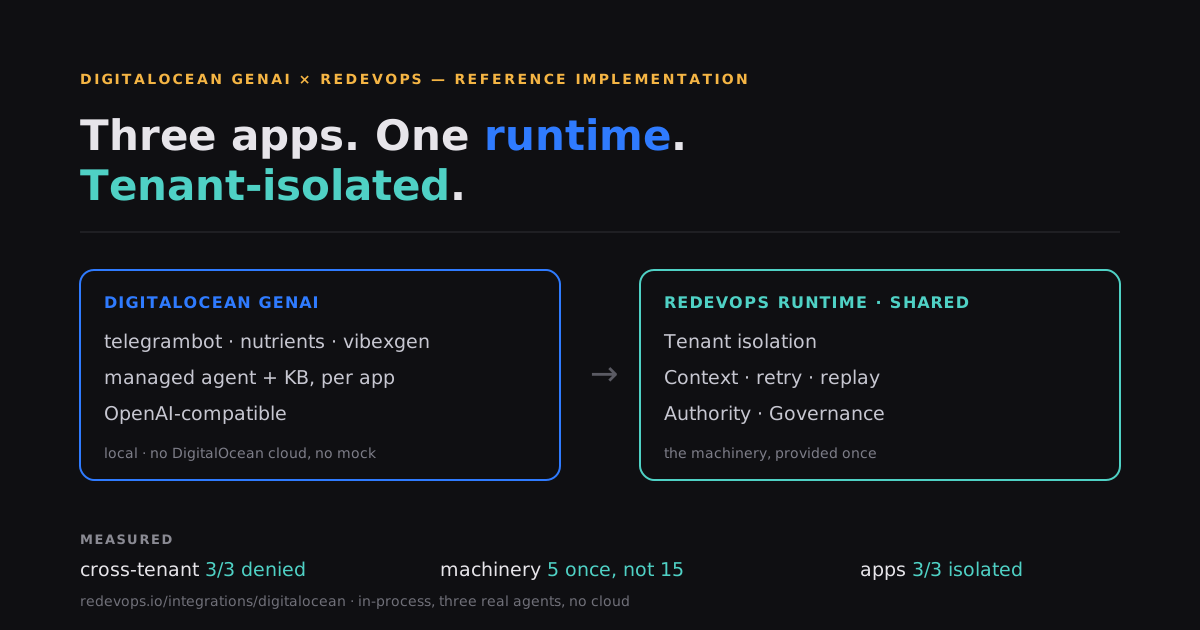
The first result is a counting exercise, and it is the whole pitch. Five production capabilities (context, retry, replay, governance, telemetry) provided once by the shared Runtime, instead of fifteen re-implementations across three apps. That number grows with every app you add. The runtime is where the machinery lives; the apps stay lean, which is the reason you were on DigitalOcean in the first place.
But sharing a runtime raises the question that makes or breaks the idea: isolation. If three apps share one runtime, can one app read another's context, spend another's authority, or get another's cached answer? On a naive shared runtime, yes, and that is a data-leak and a governance hole at once.
The boundary is the tenant
ReDevOps scopes every access to the acting tenant. Each app is a tenant with its own grants and its own private context namespace. telegrambot reads only telegrambot's knowledge base; when it tries to read nutrients' context, the runtime denies it. nutrients can generate a meal plan but cannot render a vibexgen reel: that action isn't in its grants. Across the cases, a naive shared runtime would run all three cross-tenant accesses; ReDevOps denies each one with no wrong calls, while admitting every app's own in-scope work. Cache keys are tenant-namespaced too, so the same question from two apps never returns one tenant's answer to another: the cross-tenant cache-bleed bug, closed by construction.
Three real apps, actually running
The proof is not a diagram. Three real DO GenAI agents run end-to-end on one runtime: telegrambot writes a support reply, nutrients suggests a high-protein breakfast, vibexgen writes a reel caption. All three run; all three stay isolated, each reading only its own namespace. And when one of them takes a consequential action (vibexgen publishing a reel), the shared Runtime governs it as a Mission: no authority, no publish; held for human approval; fired exactly once; zero duplicates on replay. One app's governed action, invisible and untriggerable to the others.
DigitalOcean keeps giving each app a lean agent stack. ReDevOps gives all of them one runtime underneath, so the machinery is written once, and the apps stay isolated while sharing it. That is the shape of the whole series in one slice: keep what you have; add the production runtime once.
The full DO-A…DO-E result matrix, the frozen environment, and the acceptance-bundle hashes are on the benchmark page, and the code (three real DO GenAI agents on one runtime, local, no DO cloud) is on GitHub. Same provider-neutral contract as every other slice in the reference set: NVIDIA, PydanticAI, LlamaIndex, CrewAI, Azure, Google, AWS, and now DigitalOcean. Eight integrations, one contract; new provider support is a conformance exercise on the one architecture.