CrewAI Delegates. ReDevOps Keeps Authority From Widening.
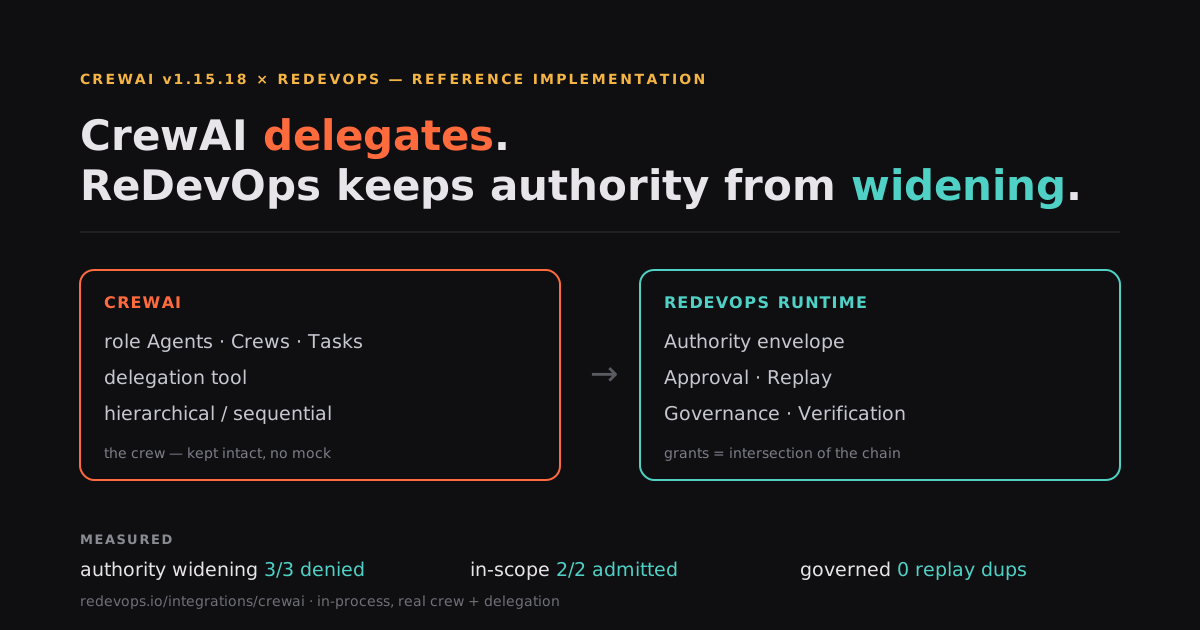
Every integration in this series looks for a framework's strongest native abstraction and tests the boundary immediately outside it. For CrewAI that abstraction is delegation: a manager agent hands a task to a coworker, a crew fans work across specialist roles. It is what CrewAI is for, and it is where the interesting question lives.
We started with feasibility. crewai is a heavier dependency than the earlier frameworks: it pinned pydantic down to 2.12.5 and protobuf to 6.x when it landed in the shared environment. So the honest first test was "does everything else still work at that floor." It does: the NVIDIA, PydanticAI, and LlamaIndex suites reproduce their exact numbers with crewai co-resident, and a real crewai crew (role Agents, a Crew, real Tools) runs in-process with the Mission SDK. No mock.
The question just outside delegation
Here is the thing a delegation framework does not answer on its own: when agent A delegates to agent B, what is B allowed to do? In CrewAI, B runs with its own tools. If B holds a "freeze account" tool, delegation fires it, regardless of whether A, the agent that delegated the work, had any authority to freeze accounts. Authority does not travel with the handoff, and nothing narrows it.
That is fine until the consequential actions are real. In an AML/KYC crew, "freeze this account" and "release these funds" are actions with blast radius. A delegate that can quietly acquire authority its delegator never held is a governance hole that grows with every hop.
ReDevOps closes it with one rule: a delegated agent's effective grants are the intersection of the delegation chain. A Compliance Officer who holds kyc:review and case:note delegates to a Risk Analyst; the analyst's effective authority is its own declared grants intersected with the officer's. Delegate again to a Junior Analyst, and the envelope narrows again. Authority is monotone non-increasing across every handoff: it can only shrink, never widen.
The flagship measures exactly this, deterministically, with no LLM so the mechanism is unambiguous. Across a chain of real crewai agents, every action a delegate attempts outside its narrowed envelope (freezing an account its delegator never held, releasing funds no one in the chain holds) is denied. Native CrewAI would run all three of those authority-widening actions. ReDevOps denies all three, with zero wrong calls, while admitting the two legitimately-scoped actions, including a freeze delegated down from a Senior Officer who actually held it. Narrowing blocks widening without blocking authorized work.
Recommendation is not authorization
The second experiment is about behaviour. A crew is good at reaching a recommendation; it is not a mechanism for deciding whether the recommendation may be executed. So the consequential action runs only through a Mission. Missing grant ⇒ zero unauthorized actions. Granted but unapproved ⇒ parked at a human gate, zero side effects. Approved ⇒ fires exactly once. Replayed after a crash ⇒ zero duplicate side effects, reconstructed from the event ledger with no re-execution. A crew consensus is a recommendation; authority to act is a separate thing, and ReDevOps keeps it separate.
There is a multi-agent corollary worth stating: authority does not pool. A crew of low-authority agents cannot combine to reach a grant none of them individually hold, and one agent's grant is not borrowable by another. Authority lives in the per-agent envelope, outside the crew's collective reach.
The crew still does the crew's job
None of this replaces CrewAI. In the third experiment a real two-agent crew (a risk analyst handing off to a decision officer) triages AML alerts end to end and gets them right, wrapped as a Mission that does not change a single decision. The framework keeps owning the agents, the roles, the delegation. ReDevOps adds the property a multi-agent handoff needs and does not carry on its own: authority that only ever narrows.
The full CR-A…CR-E result matrix, the frozen environment, and the acceptance-bundle hashes are on the benchmark page, and the code (real crewai crews, one Python env) is on GitHub. Same provider-neutral contract as the NVIDIA, PydanticAI and LlamaIndex slices; new framework support is a conformance exercise on the same architecture.