Semantic Kernel Plans the Deploy. ReDevOps Decides If It May Ship.
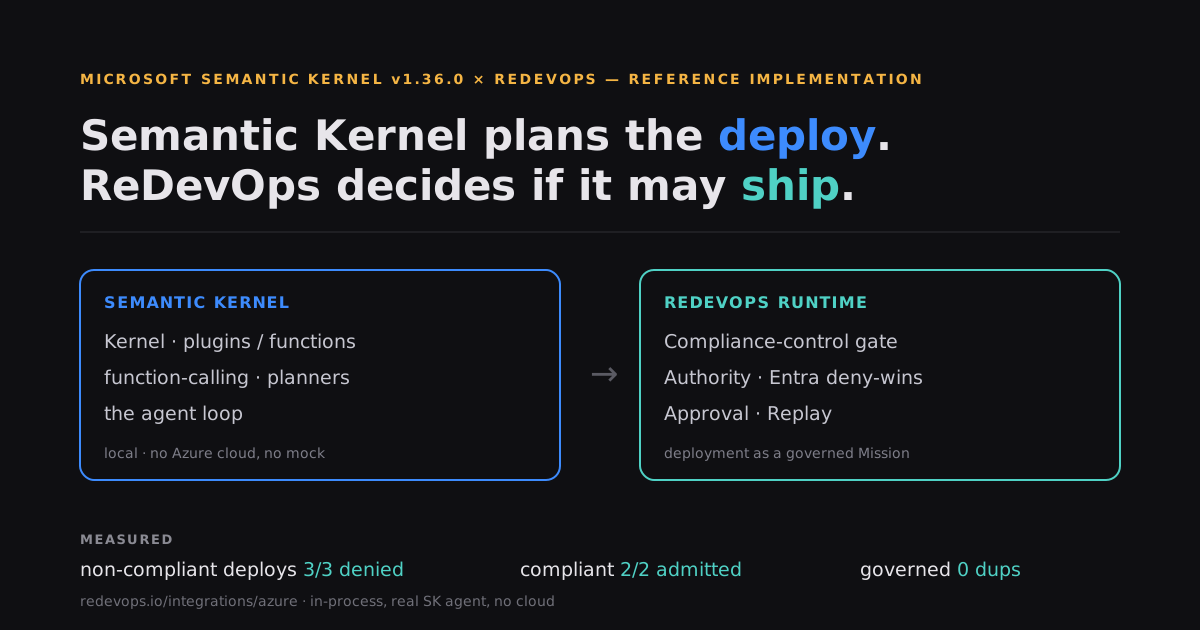
This is the first hyperscaler integration in the series, and the first thing worth saying is that it needs no cloud account. Microsoft's Semantic Kernel (the Azure agent framework) is an open-source SDK. Its agent loop and function-calling run in-process; the only outbound calls are model calls, which point at any OpenAI-compatible endpoint (a local proxy here). Azure Entra identity is represented as a policy object, so the governance semantics are exercised for real without an Azure subscription. Everything below ran locally.
There is one honest wrinkle up front. Semantic Kernel pins pydantic and openai below the floor the four framework slices share. This slice runs in its own virtual environment, leaving every earlier integration's dependency at its floor: the same provider-neutral contract, isolated dependencies. It is the first integration to do so, and it does it deliberately.
The question just outside function-calling
Semantic Kernel's strongest abstraction is function-calling: the agent decides which plugin functions to invoke and calls them. So that is where we pushed. We gave a real SK agent a deployment plugin (request_deploy(service, environment)) and asked it to deploy various services. It does exactly what a good function-calling agent does: it plans, and it invokes the function. In all five of our cases, it called request_deploy.
That is the point, and the risk. The agent invokes the deployment whenever it decides to. It has no notion of whether the target environment is compliant (encrypted at rest, running an approved image, behind a network policy, with a change approved) or whether the identity is authorized to deploy there. Function-calling is about deciding to act, separate from whether the action is allowed.
Deny-by-default, and deny-wins
ReDevOps admits a deployment only when two independent gates both pass. First, the compliance-control gate: every control required for the target environment must be evidenced. Staging requires encryption and an approved image; production also requires a network policy and a change approval. A deploy missing any required control is denied: deny-by-default, no exceptions for a fluent plan.
Second, authority. The identity's effective authority is the intersection of its framework grant and its Entra role. A CI identity might carry a framework grant for staging and production, but if its Entra role is scoped to staging, it gets staging only. A fully-compliant production deploy is still denied, because the restrictive policy governs. This is the deny-wins property: a permissive framework grant never widens cloud identity.
Across the five cases, native Semantic Kernel would proceed on all of them. ReDevOps denies the three that are missing a control or unauthorized (with zero wrong calls) and admits the two that are fully evidenced and authorized. The gate blocks the bad without blocking the good.
Shipping is a governed Mission
Even an admitted deployment does not fire on its own. It runs as a Mission: missing the deploy grant ⇒ zero unauthorized actions; granted but unapproved ⇒ parked at a human gate with zero deploys; approved ⇒ exactly once; replayed after a crash ⇒ zero duplicate deploys, reconstructed from the event ledger with no re-execution. A stateless re-run re-ships on every crash; a governed one does not.
None of this replaces Semantic Kernel. The agent keeps owning the loop, the plugins, the function-calling: it genuinely plans and invokes the deployment in every case. What ReDevOps adds is the layer between deciding to deploy and actually deploying: compliance, authority, approval, and replay. Deployment as a governed Mission.
The full AZ-A…AZ-E result matrix, the frozen environment, and the acceptance-bundle hashes are on the benchmark page, and the code (a real semantic-kernel agent, local, no Azure cloud) is on GitHub. Same provider-neutral contract as the NVIDIA, PydanticAI, LlamaIndex and CrewAI slices; new provider support is a conformance exercise on the same architecture.