Strands Proposes. ReDevOps Composes Mission Authority With IAM: Deny-Wins.
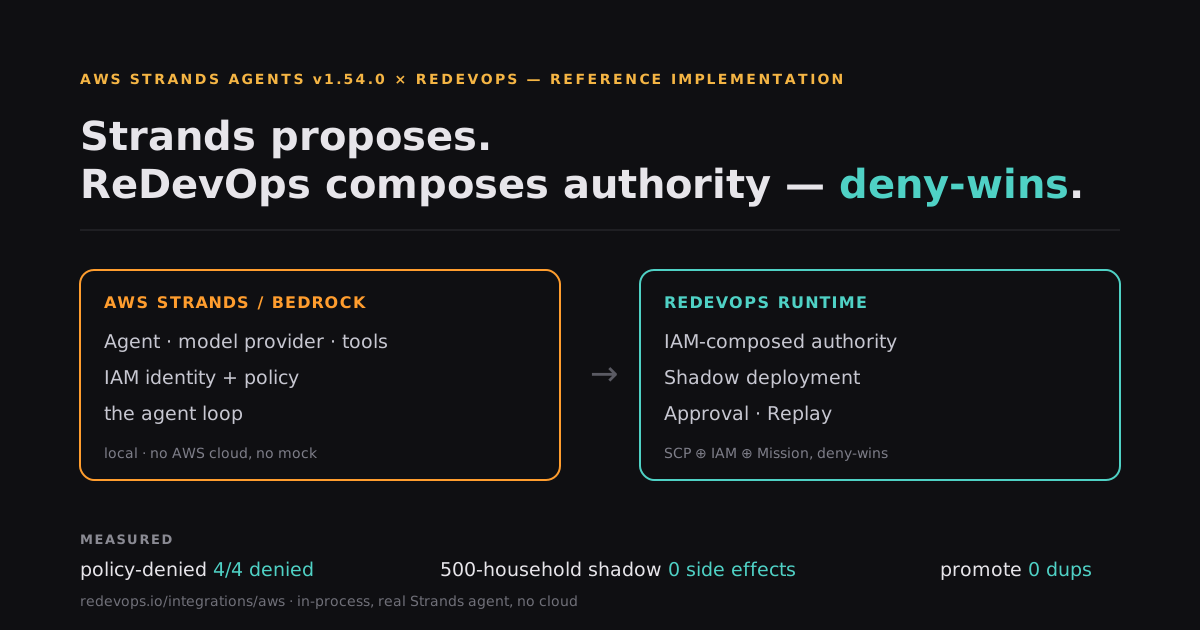
Every hyperscaler slice in this series makes the same promise up front: it runs locally, no cloud account. AWS is no exception. Strands Agents, Amazon's open-source agent SDK, runs its agent loop in-process, and with an OpenAI-compatible model provider it needs no Bedrock endpoint. Installing it didn't disturb the shared benchmark environment either; it added three packages and left pydantic, numpy and torch alone, so a real Strands agent runs alongside the NeMo, PydanticAI, LlamaIndex, CrewAI, Azure and Google slices in one venv. No AWS credentials were used anywhere below; IAM is modelled as policy documents evaluated with AWS's own rules.
The rule that defines IAM
AWS authority is IAM, and IAM has one rule that dominates all the others: an explicit Deny overrides any Allow. You can grant an identity broad permissions, but a single explicit Deny (from a service control policy, a permission boundary, a resource policy) wins. That rule is exactly the boundary just outside a Strands agent's tool calls: the agent decides to call a tool; IAM decides whether it may.
So the Wealth Manager slice composes three policy layers and evaluates them with AWS semantics. There is an organizational guardrail (an SCP that explicitly denies withdrawing funds and exporting PII, on any resource). There is the role's IAM policy (allow portfolio actions, but only on managed household accounts). And there is the Mission grant (the runtime's own layer, default-deny, that says which actions this particular mission is authorized to perform at all). An action is admitted only when no explicit Deny fires, IAM allows it, and the Mission grants it.
A real Strands wealth-manager agent proposes actions, and the composition denies the ones it should. It denies a withdrawal because the guardrail explicitly forbids it: a permissive IAM Allow could never override that. It denies a trade on the firm's treasury account because IAM allows trades only on managed households, and everything unlisted is an implicit deny. It denies a PII read the IAM policy technically permits, because the Mission was never granted it. Across the cases, native Strands would call all four denied tools; ReDevOps denies each one, with no wrong calls, and admits the two that every layer permits.
Shadow first, then promote
There is a second idea in this slice that matters more than any single deny: you do not have to act to learn. The Wealth Manager runs in shadow across 500 households. The agent proposes an action for each, and ReDevOps holds all execution (zero real side effects) while recording what the composed policy would admit. You get a full audit of what the agent wants to do, and what would be blocked, before a single trade or transfer happens.
Only when a proposal is promoted does anything execute, and then only through a Mission: no grant, no execution; parked at a human gate with zero side effects; approved, exactly once; replayed after a crash, zero duplicates. Shadow to measure, promote to act, govern the act.
Caught before the money moves
The clearest moment in the benchmark is a real one. Given a household whose client asked to pull all their cash out to a personal account, the real Strands agent does what a helpful agent does: it proposes a withdrawal. And ReDevOps denies it, through the SCP guardrail, before any transfer is even attempted. The agent kept owning the recommendation; the runtime owned whether it could execute. That is the whole slice in one line: Strands proposes, and ReDevOps composes its authority with IAM so that an explicit Deny always wins.
The full AW-A…AW-E result matrix, the frozen environment, and the acceptance-bundle hashes are on the benchmark page, and the code (a real strands-agents agent, local, no AWS cloud) is on GitHub. Same provider-neutral contract as the NVIDIA, PydanticAI, LlamaIndex, CrewAI, Azure and Google slices; new provider support is a conformance exercise on the same architecture.