We Made a Python Hot Path 42× Faster With Mojo. We're Not Integrating It Yet.
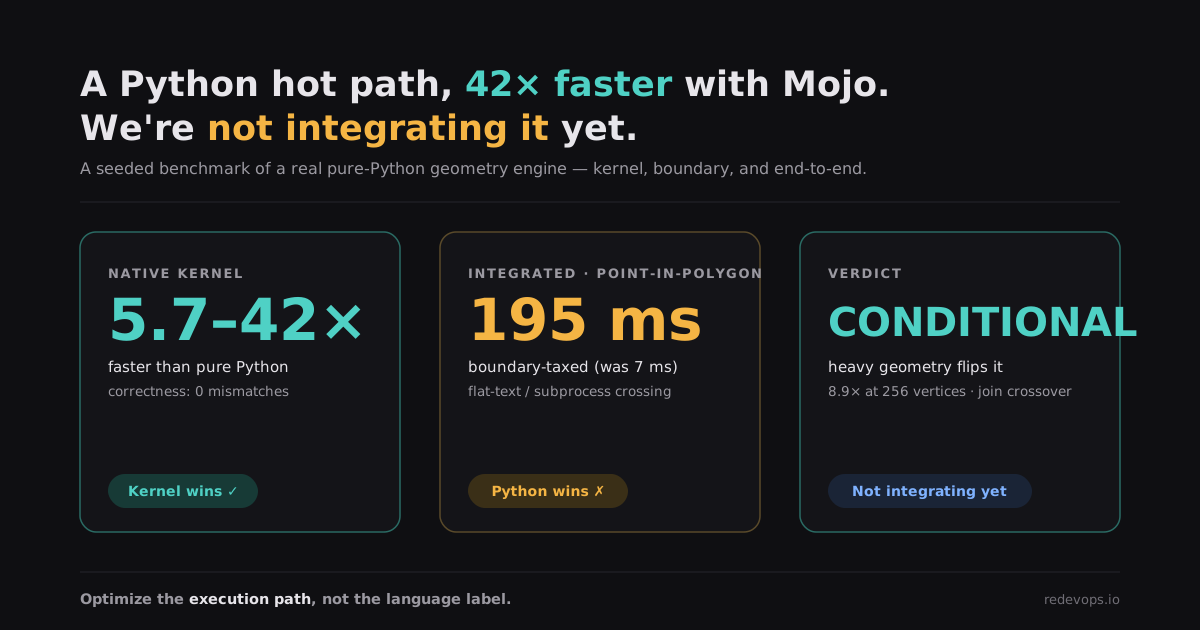
A seeded, end-to-end benchmark of a real pure-Python geometry engine ported to Mojo 1.1 (kernel, boundary, and end-to-end) and why a 42× microbenchmark still isn't a reason to add a fourth production language.
Mojo 1.1 raised an obvious question for ReDevOps: should we use it to accelerate the Python implementation of the Runtime?
Our initial code audit suggested no. Most of the Runtime is orchestration, context selection, governance, network/database I/O and LLM calls. The compute-heavy pieces already run in native libraries such as DuckDB, NumPy/BLAS, Torch and FAISS, or move to GPU implementations such as cuVS and cuDF after measured crossover points. Rewriting Python Runtime → Mojo Runtime would add substantial engineering work without necessarily changing end-to-end latency.
But we found one unusually good Mojo candidate: our pure-Python geospatial engine. It contains real CPU-bound geometry: point-in-polygon, polygon intersection and O(n²) spatial joins. It is also determinism-sensitive, with boundary decisions turning on 1e-9 and 1e-12 epsilons. So we ported it to Mojo 1.1 and built a seeded, end-to-end benchmark, including adversarial epsilon cases and a Shapely reality check.
Mojo won the kernel benchmark
First, correctness: 0 mismatches. Mojo reproduced the Python implementation's general and adversarial boundary decisions exactly: the non-negotiable precondition, since these values feed content-addressed identity downstream.
Then, speed: native Mojo kernels were 5.7×–42× faster than pure Python.
If we had stopped there, integrating Mojo would have looked obvious. We didn't.
Integration changed the result
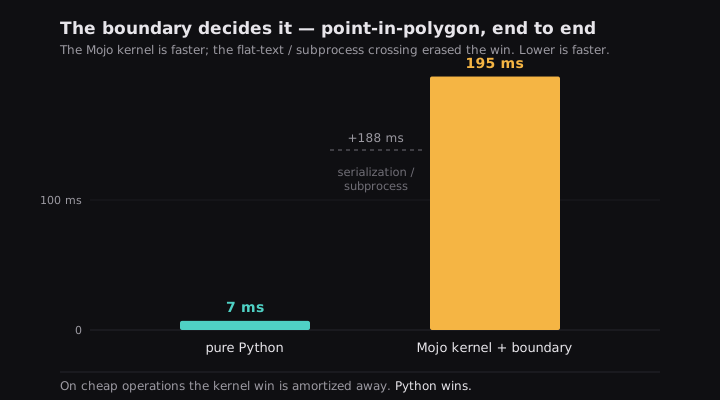
The Runtime has to move data from Python into Mojo and return the result. Our experimental implementation currently uses a flat-text/subprocess boundary. For heavy computation that cost is amortized; for cheap operations, it can erase the entire kernel advantage.
That is exactly what happened with point-in-polygon: despite the faster Mojo kernel, serialization/boundary cost grew the operation from roughly 7 ms to 195 ms, and Python won end to end.
Heavy geometry behaved differently. At 256 vertices, polygon intersection was about 8.9× faster end to end with Mojo. Spatial joins crossed over around 300 left objects × 100 right polygons: above that region, the O(n²) computation becomes expensive enough that Mojo pays for the boundary crossing. Shapely reinforced the same conclusion: faster on small point-in-polygon workloads, slower than Mojo on large joins.
| Operation | Native kernel | End-to-end (flat-text boundary) | Verdict |
|---|---|---|---|
| Point-in-polygon (cheap) | faster | 7 ms → 195 ms | Python wins |
| Polygon intersection · 256 vertices | faster | 8.9× Mojo | Mojo wins |
| Spatial join · O(n²) | faster | wins above ~300 × 100 | Mojo wins at scale |
| Correctness · all cases | - | 0 mismatches | exact |
The useful question therefore is: which execution backend is appropriate for this operation, at this scale?
Why we're not integrating Mojo yet
The benchmark classification is CONDITIONAL.
Most Runtime latency still isn't caused by interpreted Python. Existing native libraries already handle much of the local compute, and GPU acceleration handles larger workloads. More importantly, the current Python↔Mojo boundary is too expensive: the native results show real potential, but the integrated results say we should first replace the flat-text/subprocess interface with a binary or direct FFI boundary and measure the crossover again.
There is also a maintenance cost. ReDevOps already runs Python, Go and Kotlin implementations with cross-language contracts held bit-identical by a conformance suite. Another production language has to earn its place through a measurable end-to-end improvement.
So we are not rewriting the Runtime in Mojo.
The architecture that makes more sense
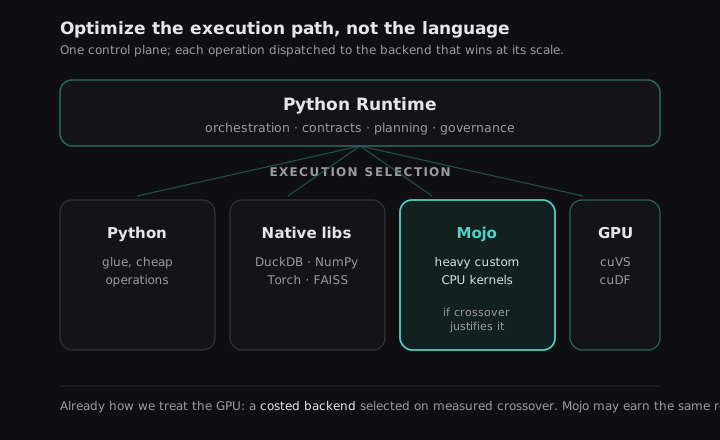
Python Runtime
    │
    ├── orchestration / contracts / planning / governance
    │
    └── execution selection
          ├── Python
          ├── DuckDB / NumPy / Torch / FAISS
          ├── Mojo — heavy custom CPU kernels, if crossover justifies it
          └── GPU — cuVS / cuDF
That is already how we approach GPU acceleration: measure where an alternative execution backend becomes worthwhile, and dispatch accordingly. Mojo may eventually occupy the same role for custom CPU kernels.
The benchmark showed that it can make one of our real pure-Python hot paths up to 42× faster while preserving deterministic behavior exactly. It also showed why that number alone is not enough.
Optimize the execution path over the language label.