A Governed Revenue Loop Across Four Business Systems
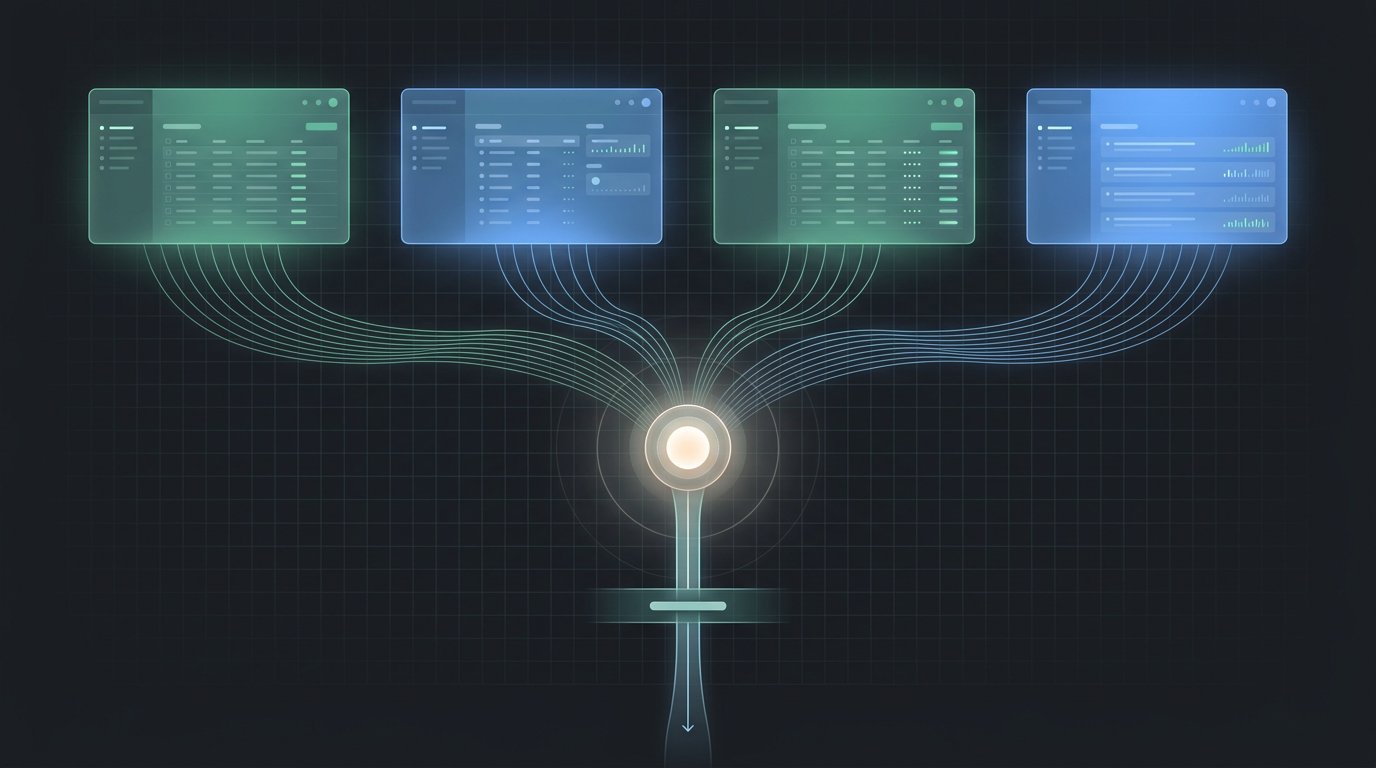
We made two business questions ("where is recoverable revenue stuck?" and "can we fulfil this quote?") into first-class Runtime capabilities. They resolve across four separate business systems through one receipted, replayable path, and every consequential action stops at a human approval gate. On a live demo the leakage question returned 131 signals (129 stalled opportunities, one unanswered quote request, one account near its plan ceiling), ranked, evidence attached, all parked on approval. Zero autonomous actions. This post is about how it's wired, and why the boring parts are the point.
The shape most revenue AI takes, and why we didn't
The common pattern is: point an LLM at the CRM, let it summarise opportunities, write emails, update fields, and add a "human in the loop" checkbox. It demos well. It also acts on stale or misattributed data and gives you no way, later, to explain why it did what it did.
Most revenue problems also don't live inside the CRM. The signal that a deal is stalling is in the CRM; the quote a customer actually asked for is in the support inbox; whether you can fulfil it is in the ERP; whether the account is near a commercial limit is in billing. No single system has enough to decide.
So we made two questions capabilities of the Runtime, resolved through the same broker as everything else:
REVENUE_LEAKAGE: where is recoverable revenue currently stuck?QUOTE_FEASIBILITY: can we fulfil this request, by when, at what margin, and what needs approval?
A DecisionNeed for either resolves through one path (resolve_decision_need): candidates matched cheapest-first, each provider call leaving a receipt on a ledger, the answer carrying the bi-temporal anchor that makes it replayable: you can reconstruct what was knowable at the moment a past decision was made. None of that is revenue-specific; it's the same broker the Supplier, Supply, Order, Counterparty and Asset Intelligence families already use. Revenue is another capability plugged in.
Internal evidence first, and it's deterministic
A rule we hold across the whole intelligence plane: answer from the tenant's own data before paying a provider. Leakage and quote feasibility are computed as cost-0 internal providers over the business's own events, reproducible as of a past decision time, so a replay never sees a later event.
The detectors are plain functions with named thresholds. A stalled opportunity is an active-stage opportunity with no future activity and a last touch older than N days. A quote follow-up gap is a sent quotation with no follow-up scheduled. An unanswered quote request is customer intent (a quote asked for in support) with no matching open quotation. Renewal risk requires at least two independent factors before it will fire: inferring churn from one weak signal is how you cry wolf. And when the evidence is thin, the correct output is do nothing yet (a valid decision, checked first).
First, prove who and what we're talking about
Before reasoning across systems, the Runtime resolves the entities. The account in Twenty, the customer in ERPNext, the contact in Chatwoot and the billing customer in Lago have to resolve to one business entity. Otherwise "re-engage Acme" can touch the wrong Acme.
Resolution walks a ladder (external id, email, domain, then name) and it is deliberately conservative. A name alone is never enough: an exact name match resolves only to PROBABLE (0.85); it takes a matching domain or email to reach RESOLVED (0.9). Only a RESOLVED entity (or an explicitly policy-approved PROBABLE) may drive a consequential action. If the match is ambiguous, the system abstains and does not guess. That sounds pedantic until an agent drafts a price using the wrong customer's contract terms.
One signal, end to end
Here is one real signal from the demo (evidence attached, action proposed, nothing done):
Signal    STALLED_OPPORTUNITY · "Enterprise iPad Deployment"
Evidence  active stage · no future activity scheduled · 42 days since last touch
Value     the opportunity's own amount, carried through as recoverable revenue
Action    Re-engage the stalled opportunity (no activity for 42 days)
Gate      required_capabilities: crm.opportunity.followup · requires approval → parked
Across the demo pipeline that pattern produced the 131 signals: 129 stalled opportunities from the CRM, one unanswered quote request from support, and one account crossing a usage threshold in billing. (The fourth system, ERPNext, powers the other capability, QUOTE_FEASIBILITY, from real price, cost, on-hand and lead-time, and doesn't produce leakage signals.) Every row carrying its evidence, and every row stopping at the gate, is the point.
The flagship: a quote, composed and still gated
The same parts compose upward into the quote-to-order step. An inbound message is classified for intent, the customer is resolved against the CRM's accounts, and the requested lines are assessed against the live ERP catalogue, producing a governed draft quote plan.
On live data the composition read a real request, classified it as a quote request, resolved a real account (a name-only match, so PROBABLE), priced it against the live ERPNext catalogue, and returned "governed draft quote ready to stage for approval": feasible, margin computed from real valuation rates, promised date derived from real lead times. A draft, carrying approval_required. It has not been sent.
The agent doesn't get to "just handle it"
Finding an opportunity and acting on it are deliberately separate operations. The Runtime can surface a stalled opportunity with its evidence, and it can rank it. But sending a message, changing a price, committing a delivery date or creating an order crosses an execution boundary, and that boundary is governed.
Being precise about where the line is today: the business-system sensors are strictly read-only, and the loop runs up to the approval gate (detect, resolve, reason, attach evidence, rank, propose), then stops. Approving a row records the decision (which trains a per-scope priority weight) and marks it ready; the execution adapters that carry an approved action back into a system of record, as a reviewable change, are the next mile, built one action type at a time. So the shape is:
observe → resolve → reason → show evidence → propose → approve → execute → verify → learn
That's a less impressive demo. It's also the architecture we'd rather put near real money.
Governance is the product
It's increasingly what is the product. Making an LLM draft a follow-up email isn't hard anymore. The hard questions are the governed ones: was this the right customer? Was the information current? Which systems contributed the evidence? Could we actually fulfil what we're about to promise? Who was allowed to approve it? What changed afterwards? Can we reconstruct the decision six months later?
That's why the Runtime keeps receipts, evidence lineage, approval state and replayable decision context. The goal is a system that can safely be trusted with more consequential ones.
The Revenue Intelligence family now runs alongside Supplier, Supply, Order, Counterparty and Asset Intelligence in rAIls. Connect the systems you have; missing integrations self-skip and are not hallucinated into existence. And when the Runtime finds something worth doing, it asks before touching the business.